
Deep stretch (yin) yoga: fascia, connective tissue and long holds
Yin yoga is a calm practice that focuses on fascia and connective tissue rather than muscle, with poses held still for minutes. We explain its benefits and principles.
The lights are dimmed, and participants stay still for minutes on the floor in positions supported by blankets and blocks; the scene resembles a rest session more than a fast-paced exercise class. The answer to the question of what yin yoga is lies exactly here: a calm practice that focuses not on muscle strength but on fascia and connective tissue, with poses gently held for long periods of 2-5 minutes. In this article we look at how deep stretch (yin) yoga works, its physiological logic, its benefits and who it suits.
What is yin yoga and how does it differ from other styles?
Yang-style classes such as Vinyasa work the muscles actively, generate heat and involve dynamic transitions. Yin yoga takes the exact opposite path: the muscles are left as relaxed as possible and the pose deepens passively with the help of body weight and gravity. The aim is to work less on muscle tissue and more on the ligaments and tendons around the joints and on fascia, the network of connective tissue that wraps muscles and organs. Because these tissues respond much more slowly than muscles, the pose must be held for a long time for an effective stretch.
Basics of fascia and connective tissue
Fascia is a network of connective tissue that wraps and connects the muscles, bones and organs of the body. Prolonged inactivity, repetitive postural faults or injuries can over time lead to stiffening and adhesions in the fascia. Yin yoga poses are thought to contribute to an increase in range of motion over time by stretching these tissues gently and for long periods. This effect works through a different mechanism from muscle stretching and therefore requires a different holding time and approach.
The flow of a typical yin yoga class
- Centring (5 min): Seated or lying on the back, you settle into the pace of the class by focusing on the breath.
- First pose series (15-20 min): Lower-body poses such as butterfly and seated forward fold, each held for 2-4 minutes.
- Hip-opening poses (15 min): Poses targeting the hip area, such as thread the needle and pigeon, are practised.
- Back and spine poses (10-15 min): Gentle spinal twists and back-lengthening poses are added.
- Full relaxation (10 min): The class ends with a long relaxation lying on the back, supported by blankets and bolsters.
Comparison: yin yoga and yang-style classes
| Feature | Yin yoga (deep stretch) | Vinyasa / Balanced Yoga |
|---|---|---|
| Muscle state | Relaxed, passive | Active, contracted |
| Holding time | 2-5 minutes | A few seconds to a few minutes |
| Main target tissue | Fascia, ligaments, tendons | Muscles, cardiovascular system |
| Heat generation | Low | Medium-high |
Potential benefits
- Fascia and connective tissue flexibility: Long holds may contribute to increased joint range of motion over time.
- Deep relaxation: Passive poses can help engage the parasympathetic nervous system and create a general sense of calm.
- Recovery support: It may help reduce tension around muscles and joints after intense training.
- Awareness: Paying attention to bodily sensations during long holds can develop overall body awareness.
- Sleep quality: Yin practice in the evening may make it easier for some participants to drift into more restful sleep.
Level and modification variations
There is no single correct form in yin yoga poses; every body feels a comfortable stretch at a different point. For those with limited flexibility, props such as blankets, blocks or bolsters can be added to raise or shorten the pose. For example, placing bolsters under the knees in butterfly pose makes it comfortable for those with limited hip opening. More flexible participants can deepen the pose by reducing props. What matters is that the stretch stays intense but bearable; you should never force yourself to a point where sharp pain is felt.
Common mistakes
- Trying to keep the muscles active: Yin yoga is a passive practice; contracting to stretch prevents the tissues from reaching the real target.
- Coming out of the pose too early: Because fascia and connective tissue respond slowly, releasing the pose after 30 seconds may not have enough effect.
- Pushing the pain threshold: What you should feel is an intense but not unpleasant stretch; sharp pain is a warning sign.
- Holding the breath: Slow, steady breathing during long holds helps the tissues relax; holding the breath interrupts this process.
Who it may not suit / who should be careful
People with joint hypermobility, that is excessive flexibility, should be careful in yin yoga's deep stretches so as not to lose joint stability, and should keep their range of motion limited. Those with an acute joint injury, severe osteoporosis or recent joint surgery should consult their physician before starting classes. During pregnancy, some deep hip-opening poses should be modified or removed from the programme; here too it is important to consult your physician.
How is progress measured?
Progress in yin yoga is measured not by gains in strength or speed but mainly by comfort and range of motion. A decrease over time in the intense tension previously felt in a pose, being able to move into a deeper version of the same pose, or a deepening of the relief felt afterwards are indicators that can be tracked. This development is usually noticed gradually over weeks or months.
Using equipment
Yin yoga classes make extensive use of supportive props such as blocks, blankets and bolsters. A block makes a pose safe by closing the distance the hand or torso cannot reach. A blanket placed under the knee or hip reduces pressure on the joint. A bolster gently supports the rib cage in supine poses and helps the shoulder and neck area relax. These props are provided to participants in our O'Soul studio.
Combining with other classes
Thanks to its recovery-focused nature, yin yoga is very well suited to practice after an intense day of Reformer Pilates, Vinyasa Yoga or strength training. When planned in the same week as a Mobility & Stretching class, it can form a comprehensive recovery routine that targets both fascia and joint mobility.
Sample 4-week plan
- Week 1: Once a week, focusing mainly on lower-body poses.
- Week 2: 1-2 times a week; hip-opening poses are added and holding time is gradually extended.
- Week 3: Twice a week; the programme is expanded by adding back and spine poses.
- Week 4: Twice a week; placed right after intense training days to observe the recovery effect.
Getting there from Beytepe and around
Yin yoga is one of the classes that is most beneficial in the evening; because it calms the nervous system, it is popular with people who want to shake off the day after work. Since our club in Yaka Beytepe is open until 23:00 on weekdays, people leaving offices along the Eskişehir road or Hacettepe's Beytepe campus can easily make it to class. For those coming from Çayyolu, Ümitköy, İncek and Konutkent, the club is a few minutes away and the complex car park is available.
Deep stretch (yin) yoga at O'Wellness Beytepe
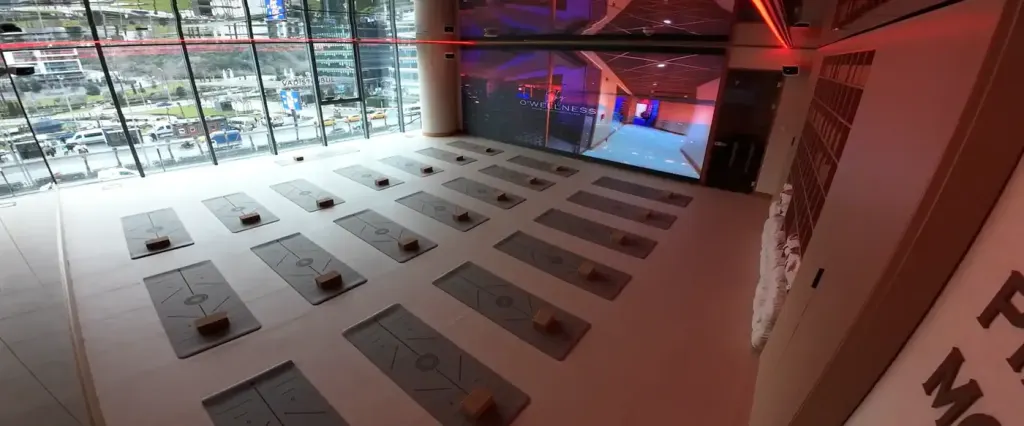
O'Wellness Beytepe operates in the Yaka Beytepe complex in Çankaya; Deep Stretch Yoga classes take place in the O'Soul studio, dedicated to yoga, mat pilates and mobility. You can check our weekly schedule for current class times and our instructors page for information about the team. We offer a free facility tour and trial session before membership; see our membership page for the founding membership pre-registration and other details.
Breathing technique and mental approach
During yin yoga, the breath is maintained as slow, deep diaphragmatic breathing. The first 30-60 seconds of each pose are usually when tension is felt most intensely; focusing on the breath during this time makes it easier for the mind to move away from discomfort and allow relaxation. Over time, a stretch of the same intensity starts to feel less uncomfortable; this is a sign of both physical adaptation and mental tolerance. Some participants may initially find long holds boring or unsettling; this reaction is normal and tends to fade with regular practice.
Group class or one-to-one?
Yin yoga is mostly practised in a group format, which offers a shared relaxation experience in a calm setting. If you have a specific joint problem or injury history, it may help to take the first few classes one-to-one to learn modifications tailored to you. One-to-one sessions can be arranged within our private services for your personal needs.
Membership and trial
The quickest way to find out whether yin practice suits you is to attend the free trial session we offer before membership. During the trial you can talk with our instructors about how to combine Deep Stretch Yoga with the other options on the class schedule. Package and founding membership details are on our membership page.
Conclusion
We can answer the question of what yin yoga is briefly as follows: a calm style of yoga that focuses on fascia and connective tissue, holds poses still for minutes, and targets deep relaxation and range of motion. It can serve as a complement to intense training programmes or as a standalone stress management tool. When practised patiently and regularly, it can provide noticeable relief for both body and mind, so it is worth seriously considering adding it to your weekly schedule on a regular basis.
Frequently asked questions
What is the difference between yin yoga and classic stretching?
Classic stretching usually focuses on the muscles and is done for shorter periods. Yin yoga targets fascia and connective tissue and requires poses to be held passively for much longer, around 2-5 minutes.
Is it normal to feel pain during yin yoga?
An intense but bearable stretching sensation is normal; sharp, stabbing pain is not, and in that case you should come out of the pose immediately.
How long does a yin yoga class last?
Classes usually last 60-75 minutes; during this time each pose is held for 2-5 minutes, with short transition breaks between poses.
Why O'Wellness Beytepe for deep stretch yoga in Beytepe, Ankara?
Regular Deep Stretch Yoga classes are scheduled in our O'Soul studio in Yaka Beytepe; you can complete the recovery side of your intense training programme with these classes.
I have joint hypermobility; can I do yin yoga?
People with joint hypermobility should be careful in deep stretches and keep their range of motion limited; it is important to tell your instructor about this before class.
Giving your body and mind this kind of space to slow down after a busy week is an important part of building a training routine that is sustainable in the long term. We recommend trying a few classes to discover your own rhythm.
To begin your deep stretch (yin) yoga journey, schedule your free trial session through our contact page.
Related posts
Yoga for Lower Back Pain: Safe Poses and a 20-Minute Routine
We explain which yoga poses help and which are risky for low back pain, and what a safe practice framework looks like. See a doctor first for severe pain.
Budokon Yoga: Where Yoga Meets the Martial Arts
Budokon yoga blends classic yoga postures with ground movements and agility drills from the martial arts. We explain its core principles, benefits and who it suits.
Aerial (hammock) yoga: the benefits of inversions and safety
The benefits of aerial yoga lie in inversions and spinal lengthening supported by a fabric hammock hung from the ceiling. We cover the principles, safety and who it suits.
