
Kettlebell Training: A Guide to the Swing, Clean and Turkish Get-Up
A practical guide to the correct technique and benefits of the kettlebell swing, clean and Turkish get-up, with a four-week starter program.
A kettlebell is almost a complete training tool on its own: it combines hip power, core stability, grip strength and cardiovascular endurance in a single implement. Kettlebell training, especially with basic movements such as the swing, clean and Turkish get-up, is ideal for people who want high returns in limited time. In this guide you will find the correct technique for the three movements, the most common mistakes and a four-week starter program.
How does a kettlebell differ from other weights?
The center of mass of a dumbbell or barbell sits in the middle of your hand; in a kettlebell it hangs below the grip point. This asymmetric structure makes kettlebell movements more dynamic and requires the core muscles to provide constant stabilization. Moreover, most kettlebell movements (swing, clean, snatch) are ballistic; that is, the movement works on swing and acceleration, not a fixed lift as in classical weightlifting. This trait turns kettlebell training into both strength and conditioning work.
Movement 1: The kettlebell swing
The swing is the cornerstone of kettlebell training and teaches the hip hinge pattern.
Correct technique
- Feet slightly wider than shoulder width, kettlebell on the floor in front of your feet.
- Hinge at the hips and grip the kettlebell with both hands, back flat.
- Hike the kettlebell back between your legs as if lightly throwing it, then drive the hips forward hard and swing it up to chest height.
- The hip snap, not the arms, produces the movement; the arms only guide the kettlebell.
- As the kettlebell falls back with gravity, catch it between your legs under control and repeat the cycle.
Common mistakes
The most common mistake is doing the movement like a squat and driving the knees forward instead of the hips; this switches off hip power and puts needless load on the lower back. Another mistake is trying to lift the kettlebell above shoulder height with the arms. In the swing, the kettlebell should stop at chest height and not rise above the shoulders (the overhead version is a separate movement called the "American swing" and requires technique).
Movement 2: The kettlebell clean
The clean is the movement pattern that brings the kettlebell from the floor or a swinging position to the shoulder (rack) position; it is the starting point for movements such as the kettlebell press and squat.
Correct technique
- Accelerate the kettlebell upward with a hip movement similar to the swing.
- As the kettlebell approaches chest height, keep the elbow close to the body and flip the wrist quickly so the kettlebell settles on the forearm.
- In the final position the kettlebell should rest comfortably where the forearm and upper arm meet, not on the outer wrist.
The most common beginner mistake is delaying the wrist flip and letting the kettlebell slam into the forearm; this can cause bruising on the wrist and forearm. Learning the movement first with a light weight at a slow tempo prevents this problem.
Movement 3: The Turkish get-up
The Turkish get-up is a complex but extremely valuable movement that requires holding the kettlebell steady in one arm while rising from the floor to standing, testing the whole body for shoulder stability, core strength and hip mobility.
| Stage | Description |
|---|---|
| 1. Starting on the back | Kettlebell in one hand, arm kept close to the body with the elbow bent |
| 2. Rising onto the elbow | The opposite hand and foot press into the floor as the torso leans on the elbow |
| 3. Rising onto the hand | Move from the elbow to a straight arm and lift the hips off the floor |
| 4. Bridge and leg sweep | The hips come to a bridge position and the back leg is brought forward |
| 5. Kneeling position | The torso rises upright and the kettlebell is held steady overhead |
| 6. Standing up | Push through the front knee to stand fully upright |
The movement is then repeated in reverse order to return to the starting position. While learning the Turkish get-up, it is recommended to practice stage by stage first with an empty hand or a very light weight; it is the kettlebell exercise that demands the most care technically.
Benefits of kettlebell training
- Builds hip power and explosiveness (through the swing and clean).
- Trains core stability in a functional way (especially the Turkish get-up).
- Increases grip strength, which matters for overall upper body strength and daily function.
- Reaches a high heart rate quickly, combining conditioning and strength in the same session.
- Develops balance and coordination, especially with unilateral movements.
A four-week kettlebell starter program
It can be done two to three days a week, with sessions of 30-40 minutes.
Weeks 1-2: Learning technique
- Kettlebell deadlift 3×10
- Swing (light weight) 4×15
- Goblet squat 3×10
- Turkish get-up (slow, unweighted or very light) 2×3 (each side)
Weeks 3-4: Load and combinations
- Swing 4×20
- Clean 3×8 (each side)
- Clean + press combination 3×6 (each side)
- Turkish get-up (light kettlebell) 3×3 (each side)
You can follow this program on your own in the functional area at O'Wellness Beytepe (sled, kettlebell, TRX) or learn it faster and more safely with Personal Training support. For those who want to reinforce kettlebell technique, classes in the O'Rise studio such as Total Body and Crunch & Core are also useful complements.
Who should be careful?
People with a history of lower back or shoulder injury should consult a sports physiotherapist or doctor before starting, especially the swing and Turkish get-up. Ballistic movements are generally not recommended during pregnancy; ask your trainer about alternative programs for this period. Raising the weight before technique is solid is the most common cause of injury in kettlebell training, so working with light weights and a technique focus in the first weeks is essential.
Advanced kettlebell movements
Once you are comfortable with the swing, clean and Turkish get-up, you can add the following movements to your program:
- Snatch: An advanced version of the swing that takes the kettlebell from the floor to overhead in one motion; demands high technique.
- Kettlebell press: Pressing the kettlebell overhead from the rack position builds shoulder and core stability.
- Double kettlebell front squat: A squat in the rack position with two kettlebells; challenges core and leg strength together.
- Renegade row: Rowing with one arm from a push-up position while balancing on the other hand; provides core anti-rotation work.
Before moving to these, it is recommended that technical mastery of the swing, clean and Turkish get-up is fully established; otherwise compensatory faulty patterns can develop in the advanced movements.
Fitting kettlebell training into the weekly plan
| Day | Focus | Sample content |
|---|---|---|
| Monday | Strength + technique | Clean + press 5×5, Turkish get-up 3×3 |
| Wednesday | Conditioning | Swing circuit (10 min EMOM), farmer's carry |
| Friday | Combination | Clean + squat + press combo, single-arm row |
This structure is a balanced start for those who want to focus on kettlebells three days a week. You can combine kettlebell work with classes such as Crunch & Core to support core development, or strengthen the conditioning side with O'Ride Cycle.
The science behind kettlebell training
Ballistic movements (swing, snatch, clean) use the mechanism of storing and releasing elastic energy in the muscle-tendon unit; this is a valuable stimulus for developing explosive power in athletes. The hip hinge also trains the posterior chain muscles (hamstrings, glutes, lower back) in a way that is neglected in daily life. For this reason kettlebell training is especially valuable for correcting the hip extension weakness created by long hours of sitting.
Returning to kettlebell training after an injury
Those who have had a lower back or shoulder injury must get approval from a doctor or sports physiotherapist before returning to the kettlebell. During the return, base strength should first be rebuilt with low-risk movements such as deadlifts and goblet squats with light weights, and ballistic movements (swing, clean, snatch) should be introduced only once pain-free full range of motion is achieved.
Comparing kettlebell and classical weight training
| Feature | Kettlebell | Dumbbell/Barbell |
|---|---|---|
| Movement type | Ballistic, dynamic | Controlled, linear |
| Conditioning contribution | High (swing, snatch circuits) | Low-medium |
| Maximum load capacity | Limited (practical weight range) | High (barbell can be loaded very heavy) |
| Technical learning curve | Medium-high | Low-medium |
Kettlebell training and recovery
Because ballistic movements work the hip and lower back muscles intensely, leaving at least 48 hours of recovery between kettlebell sessions is recommended. After an intense swing or snatch session, an easy walk, a Mobility & Stretching class or stretching with a foam roller can help reduce muscle tightness. If you feel persistent tension or pain in the lower back, lighten the next session and consult your sports physiotherapist if needed.
Starting kettlebell training at O'Wellness Beytepe
The functional area of our Beytepe facility has sled, kettlebell and TRX equipment, while the O'Rise studio offers group classes focused on total body and HIIT. The path we suggest to new members is to learn the basic swing and clean technique from our trainers during the free facility tour and trial session, then add kettlebell movements to the weekly plan gradually. For those who are unsure about technique, one-to-one Personal Training sessions are the safest starting point.
Breathing and core bracing in kettlebell training
In movements such as the swing and clean, proper breathing technique affects both performance and safety. The general rule is to exhale briefly and forcefully at the moment of the hip snap (the hardest point of the swing) and breathe in naturally during the descent. Keeping the core lightly braced throughout the movement (without clenching fully) stabilizes the lumbar region and protects the lower back. Breathing and core control are fundamentals to prioritize at every level, regardless of the weight.
A sample 8-week kettlebell progression
| Week | Focus | Sample change |
|---|---|---|
| 1-2 | Technique | Light weight, slow tempo, focus on high-rep sets |
| 3-4 | Increasing volume | Add sets, speed up the tempo slightly |
| 5-6 | Load increase | Move up one weight, keep reps constant |
| 7 | Combination | Compound movements such as clean + press, swing + squat |
| 8 | Test and review | Technique video check, plan the next block |
This progression structure keeps technique intact at every stage while raising load and complexity gradually.
Frequently asked questions
What weight should I start kettlebell training with?
A range of roughly 6-10 kg for women and 10-16 kg for men is a reasonable starting point for movements such as the swing; for technical movements such as the Turkish get-up it is advisable to start much lighter.
Is kettlebell training good or bad for back pain?
Swings and hinges done with correct technique can support lower back health by strengthening the back and hip muscles; however, if you have an existing back problem, do not start without consulting your doctor.
What facilities does O'Wellness Beytepe have for kettlebell training?
The functional area has sled, kettlebell and TRX equipment, and with Personal Training support you can learn the basic movements safely. Ask our team for current equipment information.
Which is more effective, kettlebell or dumbbell?
Both offer different advantages; the kettlebell suits ballistic and dynamic movements, while the dumbbell suits isolated and controlled ones. A good program can include both.
To develop your kettlebell technique safely, you can request a free facility tour and trial session in Beytepe.
Related posts
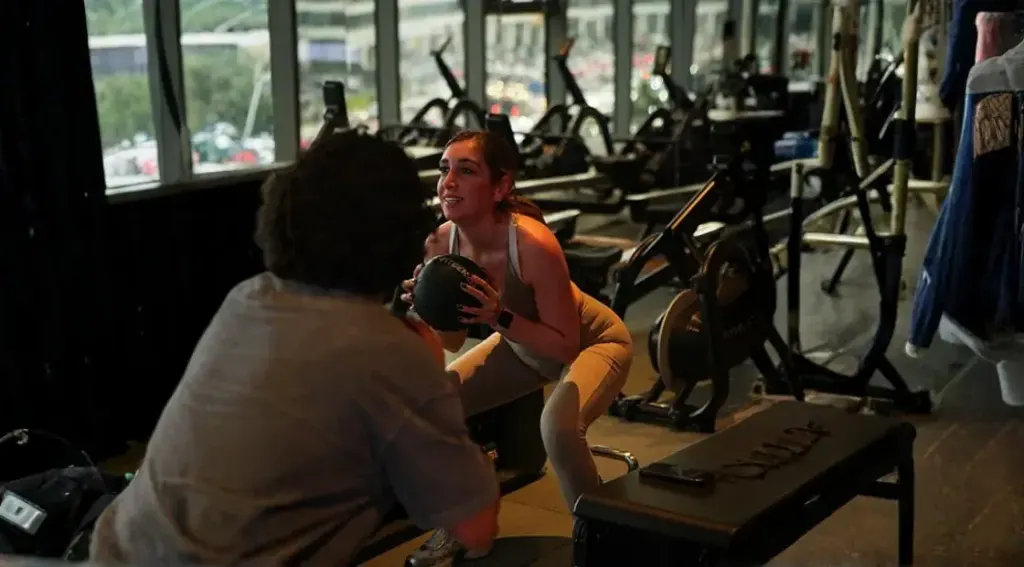
Muscle Loss After 40 (Sarcopenia) and How to Prevent It with Strength Training
Why muscle loss accelerates after 40, what the symptoms of sarcopenia are and how strength training can slow the process: a practical age-specific guide from O'Wellness Beytepe.

A Guide to Planning Your Training Around Menstrual Cycle Phases
Energy and recovery can shift across the cycle. A balanced way to plan training load flexibly by tracking your own body.
Rest Between Sets: How Long Should You Wait for Your Goal?
Rest times between sets for strength, muscle growth and endurance: how to measure them, how to adjust them and the most common mistakes.
