
Rest Between Sets: How Long Should You Wait for Your Goal?
Rest times between sets for strength, muscle growth and endurance: how to measure them, how to adjust them and the most common mistakes.
In training programmes everyone focuses on sets and reps, but rest time between sets is often overlooked. Yet rest directly determines the quality of the next set, total working volume and how long the session lasts. Vague minutes spent scrolling on a phone, or extremely short breaks taken by counting seconds, can both pull you away from your goal. In this article we explain how to choose rest between sets according to your goal.
Why does rest matter?
During a heavy set muscles use up phosphocreatine, a fast energy source. This store refills largely within a few minutes. If rest is kept short, you may do fewer reps in the next set or have to use a lighter load. In other words, rest is not just catching your breath; it is the biological requirement for performing the next set well. Nervous-system fatigue also decreases with enough rest; technique quality is preserved especially on heavy compound lifts.
Suggested ranges by goal
| Goal | Typical rep range | Rest between sets |
|---|---|---|
| Maximal strength | 1-5 reps | 3-5 minutes |
| Muscle growth (hypertrophy), main lifts | 6-10 reps | 2-3 minutes |
| Muscle growth, isolation exercises | 10-15 reps | 60-90 seconds |
| Muscular endurance | 15 reps and above | 30-60 seconds |
| Circuit training, metabolic work | Time-based | 15-45 seconds or station transition |
These values are general references. The muscle mass involved, the size of the load, your training experience and fatigue on the day change the range. Two minutes may not be enough after a heavy squat, while the same time may be too long after a biceps curl.
Long or short rest for muscle growth?
The older view said muscle building required short rest. Current research suggests that as long as you can maintain total volume, longer rest is at least as good as short rest for hypertrophy, and often better. A longer break lets you do high-quality reps in each set. If time is limited, methods such as supersets can save time: doing two movements that do not tire each other, for example a chest press and a row, back to back and then resting preserves efficiency while shortening the session.
How to measure your rest
- Start the clock or a phone timer when the set ends; do not rely on guesses.
- Let your breathing and heart rate come back toward normal during the first minute.
- Use the remaining time to prepare for the next set: adjust the weight and mentally rehearse the setup.
- When the timer ends, on heavy sets check breathing and posture once more before starting.
- Take notes: record which rep count you reached at which rest time.
Active rest and what to do between sets
During rest you do not have to stay completely still. Light mobility drills unrelated to the trained area or short walks keep circulation going. But turning it into a second workout at high intensity lowers the quality of the next set. Looking at your phone for long periods between heavy sets lets you cool down and wait longer than planned. Simple work such as breath control and light shoulder or hip mobility is a good choice between sets.
Common rest mistakes
- Using the same rest after every set: it should be adjusted to the difficulty of the movement.
- Believing short rest is a fat-burning magic trick: fat loss depends on total energy balance, not on rest length.
- Stretching the time without noticing through chatting or the phone: the result is lost tempo and a longer session.
- Waiting needlessly long between warm-up sets: they are not very tiring and can be kept short.
- Cutting rest when tired, short on sleep or in a hot environment: in those cases slightly longer rest is safer.
When time is short: fitting it into 45 minutes
If you need to shorten training on a busy day, reducing the number of exercises may be more efficient than cutting sets short. You can do two main lifts with good rest and spend the remaining time on supersets or circuits. The 45-minute plan for busy professionals that we wrote earlier is a practical example of this logic. Instead of cutting rest completely, pairing movements that do not tire each other saves both time and quality.
Fine-tuning by exercise type
Even within the same goal, not every exercise asks for the same rest. Movements that train large muscle masses such as squats and deadlifts are more tiring for both energy systems and the nervous system and need longer breaks. Smaller muscle groups, such as in lateral raises, biceps curls or triceps extensions, recover faster. For that reason, instead of fixing one rest time, splitting exercises into three groups is a practical method.
- Large, multi-joint movements (squat, deadlift, bench press): long rest, generally two to five minutes.
- Medium-sized movements (row, shoulder press, lunge): medium rest, one and a half to three minutes.
- Isolation movements (curl, lateral raise, leg extension): short rest, one to one and a half minutes.
Combining rest with reps in reserve and breathing
Alongside timing you can use feel. At the end of a set, think of how many more reps you could have done; this concept is known as reps in reserve. If the first reps of the next set feel very heavy or your breathing is still irregular, it makes sense to wait a little longer. Conversely, if breathing is calm and muscles are ready, lengthening the rest offers no benefit. As a quick check, being able to breathe comfortably enough to speak is a good sign for starting again.
Differences in experience, age and recovery
Beginners may progress with shorter rest than experienced lifters in the first months because the absolute load they lift is lower. As load rises, the rest naturally lengthens. As age advances and when sleep is short, recovery may slow; in these periods slightly longer rest and a reasonable total set count are more productive. In situations such as pregnancy, chronic conditions or cardiovascular medication, consult your physician for the intensity and rest plan.
Reading your progress through rest
If you write rest time next to sets and reps in your training log, an interesting picture emerges. Being able to do the same reps with the same load and shorter rest shows that your conditioning has improved. Doing one more rep with the same rest is your strength. These two measures complement each other and let you see progress not only through kilos but also through quality.
A sample session: writing rest into the plan
| Exercise | Sets x reps | Rest |
|---|---|---|
| Squat | 4 x 5 | 3 minutes |
| Dumbbell press | 3 x 8 | 2 minutes |
| Row | 3 x 10 | 90 seconds |
| Lateral raise | 2 x 15 | 60 seconds |
Notice that in this example the heaviest movement using the most muscle has the longest rest and the smallest muscle groups the shortest. The whole session, including warm-up, may take about fifty to sixty minutes; if time is limited you can pair the last two movements as a superset to shorten it. Writing the times into your programme also reduces decision fatigue in the middle of training.
In the first weeks you do not need to apply these times exactly. The aim is to find a personal rhythm that protects set quality and finishes the session in a reasonable time. Notes taken over two or three weeks clarify this rhythm and let you make small corrections if needed.
Planning your session flow at O'Wellness Beytepe
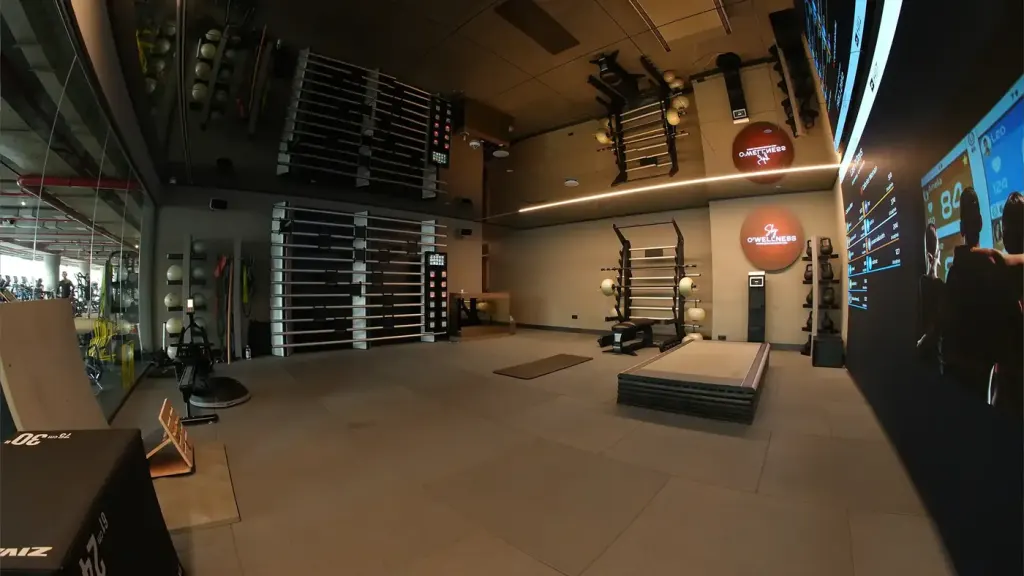
At O'Wellness Beytepe the strength and cardio area is planned together with the functional area. The club is opening very soon; the exact opening date has not yet been announced and founding member pre-registration is being taken. If you want to personalize your programme, including rest times, Personal Training can help. In group classes, rest is managed by the trainer according to the format; in classes such as HIIT and Tabata, breaks are limited and planned.
Is it harmful if I rest too long between sets?
It is not harmful, but long rests needlessly extend the session and may cause you to cool down. Going beyond five minutes on heavy sets generally offers no extra benefit.
Does short rest burn more fat?
Short rest keeps heart rate high during training and can slightly raise energy expenditure, but fat loss depends on total energy balance. Resting so briefly that you lose strength generally offers no advantage.
Should I use these times for warm-up sets too?
No. Warm-up sets are much lighter than working weight; 30-60 seconds between them is usually enough. Rest can be lengthened as you approach working sets.
In group classes, do I decide my own rest?
The trainer sets the format, but you can adjust intensity or movement to your level. If needed, you can always tell your trainer and sit out a round.
Rest time is one of the variables as important as weight and least attended to. Choose the range that fits your goal, measure it, record it and adjust when needed. Even a small timer can quietly support your progress. You can check the links below to plan your training in Beytepe.
Related posts

What Is Progressive Overload? The Science Behind Strength Gains
The body only adapts to loads slightly beyond what it is used to. The physiology of progressive overload, its four variables and how to apply it step by step.

Warm-Up and Cool-Down: 10-Minute Routines That Prevent Injury
Why should you warm up with dynamic movement instead of static stretching? A guide to lowering injury risk with 10-minute warm-up and cool-down routines.
Triathlon Preparation: Balancing Swimming, Cycling and Running
A triathlon preparation guide: weekly distribution of the three disciplines, swim options in Ankara, bike and run sessions, transitions and a 12-week framework.
