
Reformer Pilates or Mat Pilates? Differences, Benefits and the Right Choice
We compare Reformer and Mat Pilates in terms of resistance, target group and combination to help you make the right choice.
One of the most common questions from newcomers to the studio is whether Reformer Pilates or Mat Pilates suits them better. Both methods draw on the same six core principles, but the tools used, the way load is applied and the feeling they leave are quite different. In this article we look at the difference between Reformer Pilates and Mat Pilates with concrete examples, from the mechanics of the machine to target groups, from cost and time balance to the ideal combination.
The core mechanical difference: spring resistance vs bodyweight
Mat Pilates is done on the floor using only bodyweight and gravity; resistance is fixed and the difficulty of a movement is mostly adjusted through position and lever length. Reformer Pilates brings in a sliding platform (the carriage), springs of different tension, a foot bar and straps. By changing the spring setting you can make the same movement easier or harder within seconds. This flexibility makes the Reformer a useful tool for both rehabilitation and advanced strength work.
Movement repertoire and variety
In Mat Pilates the movements are limited to the floor; there is a classic sequence done lying on the back, lying face down, lying on the side and sitting. On the Reformer, thanks to the platform and straps, you can work standing, kneeling, sitting, side-lying and even balancing on the foot bar, and the repertoire reaches more than 250 variations. This breadth is the main reason Reformer classes look more varied and visually more dynamic than mat classes.
Which suits whom?
| Criterion | Mat Pilates | Reformer Pilates |
|---|---|---|
| Equipment needed | Just a mat | Requires a Reformer machine |
| Suitability for beginners | Easy to access but core control is harder | Easier to learn with spring support |
| Lower back/neck sensitivity | No support, some movements are demanding | Safe modification with strap and platform support |
| Group size | Usually a larger studio class | Limited machines, small groups |
| Rate of progress | Limited by bodyweight | Gradual, faster progress by changing springs |
| Cost | Usually more economical | Higher because of equipment and small groups |
Differences in muscle activation and feedback
In Mat Pilates, feedback relies largely on the instructor's observation; because the floor is fixed, some asymmetries can go unnoticed. On the Reformer the platform moves, so left-right imbalance, compensation or loss of control shows up immediately: if the platform wobbles or the spring returns unevenly, the movement is not being done correctly. This lets the instructor correct faster and shortens the learning process.
Core, balance and flexibility gains
Both methods target the deep muscles that support the spine, above all the transversus abdominis; various studies have shown that Pilates reduces pain and functional limitation in chronic lower back pain. An added plus of the Reformer is that it speeds up flexibility gains by lengthening muscles under load (eccentric work). Mat Pilates, on the other hand, is a handy option for those who want to develop balance on a stable surface and practise anywhere without equipment. If you are looking for a class focused on balance and mobility, the Mobility & Stretching class in the O'Soul studio is also a good complement.
Which should you choose, and when?
- If you are starting from scratch and have lower back or neck sensitivity: Starting on the Reformer is safer and more motivating thanks to spring support.
- If you are short on budget and time, or want to practise at home too: Mat Pilates is a flexible complement.
- If you are aiming for advanced strength and stability: The Reformer's gradual load increase allows faster progress.
- If you love group energy and training to music: Mat Pilates classes are usually larger and more upbeat.
In reality the two methods are not rivals but complementary tools. The O'Wellness Beytepe weekly timetable includes classes both in the Reformer Pilates studio and Mat Pilates in the O'Soul studio. You can find more about how the Reformer works and its benefits on our Reformer Pilates page.
Combination suggestion: using both together
For many people a balanced start is two Reformer sessions and one mat session a week. Reformer sessions build strength and control, while the mat session consolidates these gains through a wider range of motion. Adding complementary classes such as Barre or Deep Stretch Yoga also supports muscular balance and flexibility. See our weekly timetable page for sample weekly combinations.
Equipment and technical details
The Reformer consists of the sliding platform (carriage), colour-coded springs, the foot bar, shoulder rests and straps. Spring colour usually indicates resistance level; yellow and red correspond to light resistance, blue and black to heavier resistance. In Mat Pilates the main piece of equipment is your own body; although some classes are enriched with small balls, bands or weighted bars, the principle stays the same. The O'Wellness Beytepe Reformer Pilates studio is equipped with Balanced Body Reformers and each session is limited to a maximum of 6-8 people, so the instructor can follow every participant's spring setting and alignment individually.
Who is it not suitable for, or who needs care?
- People with serious balance problems: The Reformer's moving platform can be challenging at first; start gradually with one-to-one sessions.
- People with an acute back or neck injury: Neither method should be started without a doctor's approval; mat movements requiring flexion in particular are not suitable in the acute phase.
- People working with straps for the first time: Using straps on the Reformer can be confusing in the first sessions; it should be learned with an instructor.
- People short on time: Reformer sessions depend on booking and studio hours, whereas Mat Pilates can be done flexibly at home.
If you have a chronic condition, it is important to consult your doctor before deciding which method to start with.
How is progress measured?
In both methods, progress is not limited to being able to do harder movements. The indicators below help you track your development concretely:
- Spring resistance and reps (Reformer): Being able to do the same movement with control on a heavier spring over time.
- Range of motion (both): Increasing ease in spinal articulation and hip flexion.
- Control and stability (both): The platform or body moving without wobbling or jerking.
- Breath-movement coordination: Making exhaling on effort automatic.
- Impact on daily life: Improved posture, less lower back pain, less fatigue during the day.
Common mistakes
The most common mistake in Mat Pilates is pulling from the neck and holding the breath; trying to lift with the neck muscles instead of the abdominals puts unnecessary load on the spine. On the Reformer the most common mistake is letting the spring go without control; the return of the platform is as important as the pushing phase, and a noisy, fast return signals loss of control. In both methods the idea that heavier or harder is better is wrong; correct form is worth far more than load, and staying at the level your instructor recommends leads to faster progress in the long run.
A sample member's experience: the decision process
Imagine a member who spends long hours in the office and feels mild tension in the lower back. At the first assessment the instructor notices that some mat movements, such as the supine double leg lift, could put too much load on the spine at this stage and recommends starting on the Reformer. With spring support, the movements are done within a pain-free range. After four or five weeks, once core control and spinal awareness have improved, one Mat Pilates class a week is added to the programme. This gradual transition is a typical example of how the two methods complement each other.
A sample 8-week transition plan
For those who want to move gradually from Reformer to Mat Pilates, or from mat to Reformer, the plan below can be a starting point:
| Week | Focus | Class mix |
|---|---|---|
| 1-2 | Basic form and breathing | 2x Reformer (one-to-one or small group) |
| 3-4 | Consolidating core control | 2x Reformer + 1x Mat Pilates |
| 5-6 | Broadening the repertoire | 2x Reformer + 1x Mat Pilates + 1x Barre |
| 7-8 | Endurance and flow | 3x Reformer + 1x Mat Pilates |
This plan is not a fixed prescription; your instructors adjust it week by week according to your feedback and progress. If you want to add a strength component, you can also consider the Total Body class in the O'Rise studio.
Comparing cost and time planning
Because of the limited number of machines and the small-group format, Reformer sessions usually require a higher membership or package fee than mat classes. This difference is balanced by personalised feedback, small groups and the scalable resistance system the machine offers; many people judge the difference by the rate of progress they achieve relative to the time invested. In terms of time, Mat Pilates needs no equipment and can also be done at home, which is an easy way to keep continuity in weeks when you cannot get to the club. By sharing your budget and schedule with our team, you can plan the most suitable combination together; see our membership page for current membership options.
The role of the instructor
Whichever method you choose, the instructor's experience directly affects the result. On the Reformer the instructor personalises spring settings and strap use to your body; in Mat Pilates it is important that they can suggest the right modifications, such as placing a cushion under the knee or changing the leg angle. At O'Wellness Beytepe our instructors are planned to teach in both Reformer and mat formats; the team will be introduced on our trainers page as it is announced.
Frequently asked questions
Is Reformer Pilates more effective than Mat Pilates?
Effectiveness is not one-dimensional; the Reformer offers advantages in gradual loading and supported movement, while Mat Pilates offers accessibility and practicality. Depending on your goal, both are effective.
Can I start both at the same time?
Yes, it is possible to combine both in the same weekly programme. If you are a beginner, we recommend first gaining basic control on the Reformer and then moving on to mat classes.
Can Mat Pilates be done at home, and is a studio essential for the Reformer?
Mat Pilates can be practised at home; the Reformer requires a special machine, so it should be done in a studio.
Can I take both classes with the same membership at O'Wellness Beytepe?
For up-to-date information on membership coverage and the founding membership pre-application, see our membership page or get in touch with us.
Where in Beytepe, Ankara can I find both classes under one roof?
At O'Wellness Beytepe in the Yaka Beytepe complex, the Reformer Pilates studio with Balanced Body Reformers and the O'Soul studio where Mat Pilates classes are held share the same weekly timetable; it is a few minutes from Çayyolu, Ümitköy and the Hacettepe Beytepe campus.
Book a free facility tour and trial session via our contact page so we can decide together which type of Pilates suits you.
Related posts
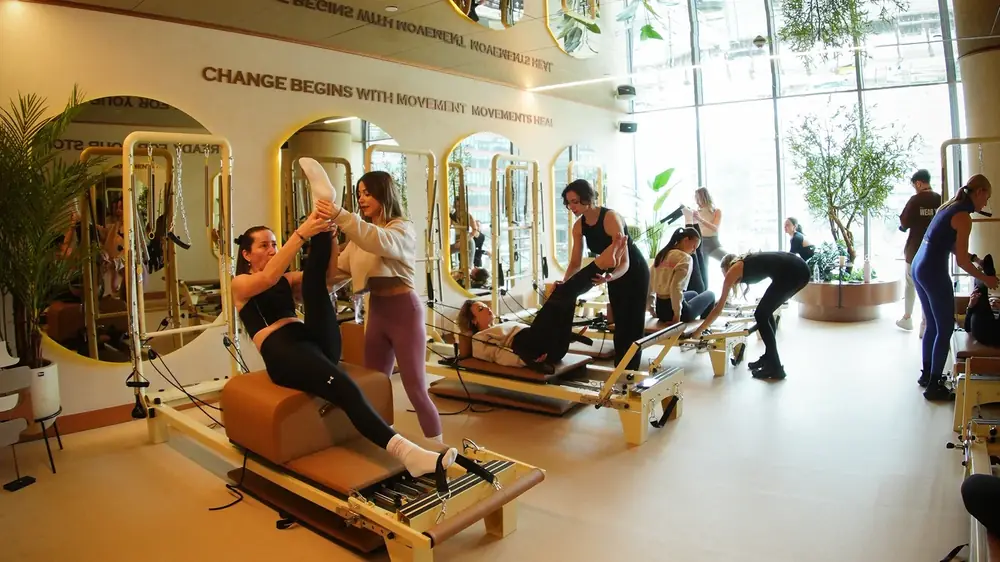
Is Muscle Soreness After Reformer Pilates Normal? Recovery Tips
Muscle soreness after Reformer Pilates is usually a harmless adaptation response. We explain the causes, how to recognise pain that needs attention and the methods that speed up recovery.
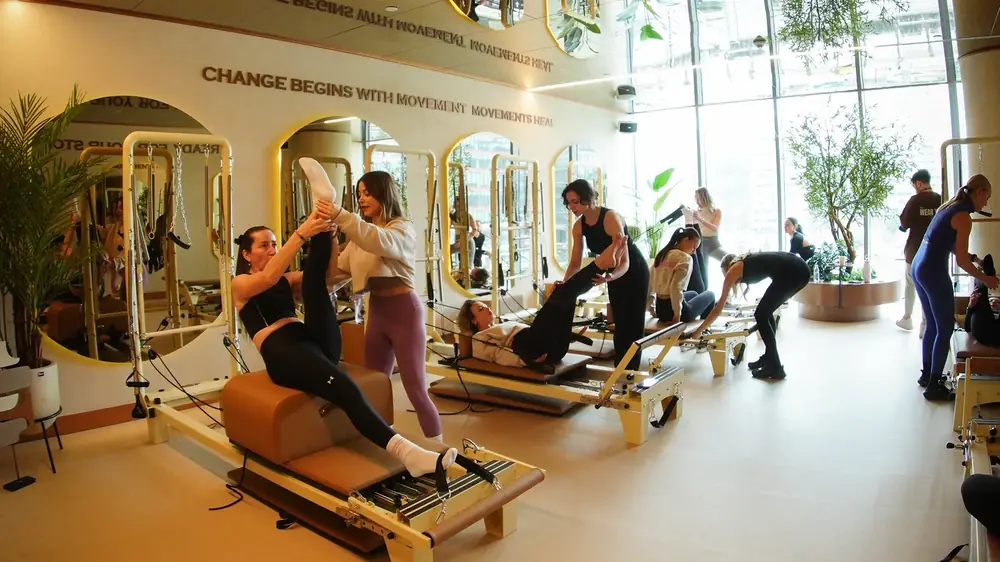
Reformer Pilates for Men: Why Strength Athletes Are Turning to the Reformer
Why are strength athletes turning to the reformer? We explain its contribution to mobility, deep core control, asymmetry correction and eccentric control.
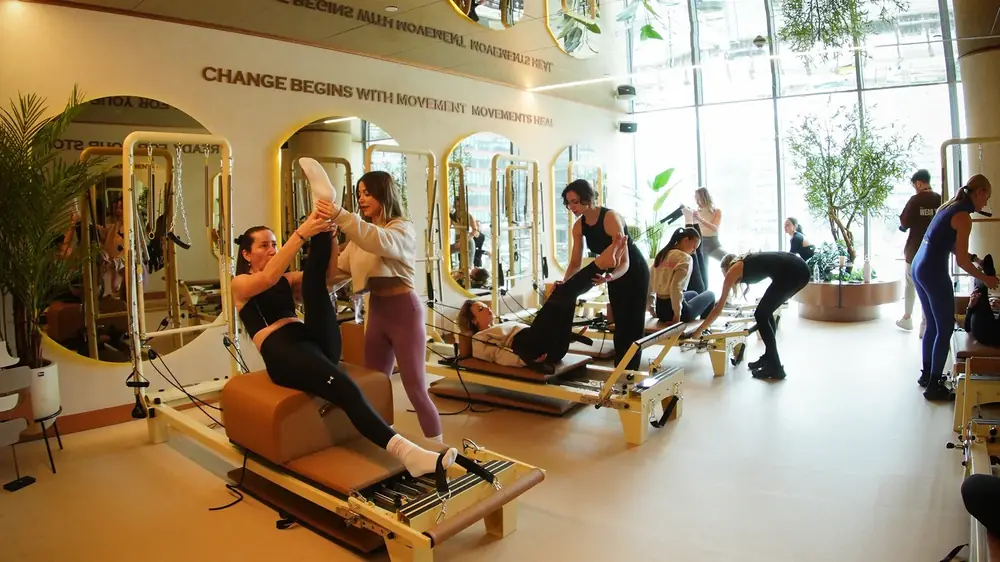
Laptop Shoulders: Posture Support with Reformer Pilates
Hours of leaning toward a screen can carry the shoulders forward and the head ahead. We explain how reformer pilates' controlled pulling and opening movements can support posture.
