
Group Classes Guide: Formats, Levels and the Right Class for You in Beytepe
Compare the class families at O'Wellness Beytepe by intensity, level and goal; this guide includes a four-week beginner plan and weekly combinations.
Group classes are one of the easiest ways to build a regular training habit: the time is fixed, an instructor is waiting for you, the programme is ready and the community supplies the motivation. Still, choosing the right format among dozens of options can be confusing at first. In this guide we compare the class families at O'Wellness Beytepe by goal, intensity and level, and offer weekly combinations for people who live and work along Ankara's western corridor.
Why do group classes work so well?
Research shows that people who exercise in groups stick to their programme noticeably better than those who train alone. There are three reasons: social accountability (skipping a booked class is harder), instructor guidance (you never have to work out the next move) and rhythm with music (perceived effort drops). At O'Wellness Beytepe, group classes run in the O'Soul and O'Rise studios, the Reformer Pilates studio and the functional area, within opening hours of 06:00–23:00 on weekdays and 08:00–23:00 at weekends. You can check which classes your membership includes on the membership page.
Studios and class families
O'Rise studio — cycle, HIIT, strength and core
O'Rise is Beytepe's highest-energy studio. O'Ride Cycle is a 30–45 minute indoor cycling class set to music; because you set the resistance yourself, it suits every level, is gentle on the joints and burns a lot of calories. O'Hiit, HIIT and Tabata consist of short intervals at maximum effort; the calorie burn that continues after the workout (EPOC) is their best-known effect. Total Body works every muscle group through compound movements, Crunch & Core is an intense 30-minute trunk session, and Booty Class targets the glutes and hamstrings.
Functional area — sled, kettlebell, TRX
The functional area hosts multi-joint work that mimics everyday movement, using sled pushes and pulls, kettlebells and the TRX suspension system. Cardio-focused formats such as Cardio Kickbox and Step Cardio, along with station-based circuits, are ideal for anyone who wants to combine conditioning and strength in one session.
O'Soul studio — yoga, mat Pilates and mobility
The yoga family includes Vinyasa (dynamic flow), Balanced Yoga (a balance of strength and flexibility) and Deep Stretch (yin-based recovery with long holds). On the Pilates side there is Mat Pilates, and for mobility there are Mobility & Stretching and Barre. With its soft lighting and music, O'Soul is the place for recovery days.
Reformer Pilates studio
Reformer Pilates classes use Balanced Body reformers with a maximum of 6–8 people per session. They are a solid part of any weekly plan for core strength, posture and flexibility. See our Reformer Pilates page for details.
Intensity and level table
| Class | Intensity | Duration | Level | Main goal |
|---|---|---|---|---|
| O'Ride Cycle | High | 30–45 min | All levels | Cardio, fat loss |
| O'Hiit / Tabata | Very high | 30–45 min | Intermediate–advanced | Conditioning, fat loss |
| Total Body | Moderate–high | 45 min | All levels | Strength, endurance |
| Booty Class | Moderate–high | 45 min | All levels | Glute strength, shaping |
| Barre | Intermediate | 45 min | All levels | Toning, posture |
| Reformer / Mat Pilates | Low–moderate | 50 min | All levels | Core, posture, flexibility |
| Vinyasa / Balanced Yoga | Intermediate | 55 min | All levels | Flexibility, balance, mind |
| Deep Stretch / Mobility | Low | 30–55 min | All levels | Recovery |
Weekly combinations by goal
Losing weight
Monday O'Ride · Tuesday Total Body · Wednesday rest or Mobility & Stretching · Thursday O'Hiit · Friday Booty Class · Saturday Balanced Yoga. This layout gives you three high-intensity classes, one strength class and one recovery class per week; combined with a balanced nutrition plan, clear changes can appear within 12 weeks.
Toning up and improving posture
Reformer Pilates ×2 · Barre ×1 · Total Body ×1 · Mobility & Stretching ×1. This mix strikes a good balance between strength and control.
Conditioning and performance
O'Ride Cycle ×2 · Total Body or a functional circuit ×1 · Tabata ×1 · Deep Stretch Yoga ×1. Members with an athletic profile can pair this plan with the Athletic Performance service in Beytepe for a more structured calendar.
Stress management and flexibility
Vinyasa Yoga ×2 · Reformer Pilates ×1 · Balanced Yoga ×1 · Deep Stretch Yoga ×1.
Beginners
For the first four weeks, Mat Pilates, Total Body with light weights, O'Ride at your own resistance and Mobility & Stretching are enough. We recommend moving on to high-intensity classes only after week four.
A closer look at the class families: who are they for, how hard are they?
You don't need to try every class on the timetable at once; it is enough to know which family fits your goal and your current fitness. Below we break down each family by difficulty and suitable profile.
Cycle family
Because you control the resistance in O'Ride Cycle, beginners can join comfortably. The joint load is low, which makes it a good option for people avoiding jumping movements because of knee or back complaints. If you want to work with power and cadence targets at a more advanced level, we suggest at least 6–8 weeks of regular cycling first; a heart rate strap makes monitoring your pulse easier.
Cardio and HIIT family
O'Hiit, HIIT and Tabata progress through short, hard intervals and suit participants with healthy joints and at least moderate fitness. Beginners can adapt during the first weeks with the lower-tempo alternatives the instructor shows. Cardio Kickbox demands coordination but involves no contact, so no combat sports background is needed. Step Cardio is fun for people who enjoy following choreography and have a good sense of rhythm; getting used to the steps can take a few classes.
Strength and core family
Total Body suits every level and everyone chooses their own weights. Station-based circuits in the functional area involve transitions, so they require moderate fitness. Booty Class and Crunch & Core are region-focused and open to all levels; if you have had surgery in the lower back or hip, we recommend consulting your doctor and informing the instructor before you start. If you are using technical equipment such as kettlebells or the sled for the first time, learn the form from the instructor in your first class.
Flexibility and mobility family
Mobility & Stretching is open to everyone and especially recommended on recovery days. Deep Stretch Yoga consists of yin-based, long holds; people with hypermobile joints should work without forcing positions and follow the instructor's cues.
Pilates and barre family
Mat Pilates is a low-impact class focused on core and posture; after childbirth it is one of the options that can be started gradually with medical approval. Barre aims at toning through small-range movements and isometric holds; since you work with the support of a bar, it also suits people who lack confidence in their balance. Reformer Pilates uses a spring resistance system; if you have back or spinal problems, we recommend getting your physiotherapist's approval.
Yoga family
Vinyasa is a moderate-tempo flow that links breath and movement. Balanced Yoga balances strength and flexibility. Deep Stretch, with its slow pace, is a good choice for calming the nervous system after a busy week. If you experience dizziness or blood pressure swings, let the instructor know before inverted positions.
Sample weekly plan: a balanced week
The table below is a general framework for spreading different class families across a week. Always check the weekly schedule page for current days and times.
| Day | Morning | Evening |
|---|---|---|
| Monday | O'Ride Cycle | Mobility & Stretching |
| Tuesday | Total Body | Vinyasa Yoga |
| Wednesday | Rest or Mobility | O'Hiit |
| Thursday | Mat Pilates | Booty Class |
| Friday | O'Ride Cycle | Barre |
| Saturday | Tabata | Deep Stretch Yoga |
| Sunday | Rest, a walk or light stretching | — |
This layout includes two recovery classes, two strength classes, two cardio classes and one yoga class per week. You can adjust the ratios to your goal and ask our instructors for one-to-one advice. Someone who wants more strength work can replace Vinyasa Yoga with a second Total Body or a functional circuit; someone who prioritises flexibility can swap one of the cardio classes for Deep Stretch Yoga. What matters is not that the plan looks perfect on paper, but that you can actually follow it every week, whether you come from Çayyolu, Ümitköy or the Hacettepe Beytepe campus.
The first 4 weeks for beginners
If you are new to group classes, your body needs time to adapt to new movement patterns and load. Progressing gradually rather than jumping straight into the most intense classes lowers the risk of injury and makes it easier to keep going in the long run.
Week 1
Two classes a week is enough: one Mat Pilates and one Mobility & Stretching. The aim is to learn the movements and keep muscle soreness under control.
Week 2
Add a third class: Total Body with light weights or O'Ride Cycle at your own resistance. Try to keep your perceived effort around 5–6 out of 10.
Week 3
You can move up to a fourth class; a moderate-intensity option such as Barre or Vinyasa Yoga works well. At this stage you should notice that muscle soreness has eased compared with the first weeks.
Week 4
If you feel ready, you can try your first high-intensity class (O'Hiit or Tabata) at a lower tempo. Telling the instructor you are new means they can show you suitable alternative movements.
Common mistakes
- Choosing the wrong class: Starting straight with Tabata or O'Hiit without a fitness base usually leads to early burnout and dropping out. A gradual transition is far more sustainable.
- Overloading: Taking two high-intensity classes back to back on the same day (for example Tabata right after O'Ride) shortens recovery and can reduce performance. Put at least a day or a recovery class between hard sessions.
- Missing the warm-up: Arriving late and skipping the warm-up raises the risk of injury; get to the studio at least 5 minutes early.
- Wrong weight or resistance: Choosing loads that are too heavy in Total Body or functional circuits breaks your form; start with a load you can control and increase gradually.
- Sticking to one family: Taking only cardio or only flexibility classes leads to unbalanced progress; bring strength, cardio and flexibility together in your weekly plan.
How do you track your progress?
Progress in group classes can be tracked through feelings as well as numbers. The indicators below help you see change over time:
- Perceived effort: Finishing the same class at the same tempo with less strain shows your fitness is improving.
- Resistance and weight: If the resistance you use in O'Ride or the weight you lift in Total Body is going up, your strength is developing.
- Recovery time: If you return to normal faster after a hard class, your cardiovascular capacity is increasing.
- Movement quality: Receiving fewer corrections from the instructor indicates that your technique is settling in.
- Consistency: Keeping your weekly class count steady for 8–12 weeks is the clearest proof that the programme is sustainable for you.
If you would like numerical tracking, you can request a one-to-one assessment from our instructors or review your measurements regularly in Personal Training sessions.
Who should be careful, and when?
Group classes are designed with a wide range of participants in mind, but some situations call for caution or medical approval. People with cardiovascular disease, uncontrolled blood pressure, recent surgery, pregnancy, a joint replacement or chronic back or neck problems should consult their doctor and inform the instructor before starting. High-impact classes such as Tabata, O'Hiit and Step Cardio are not recommended at first for people with knee or back problems; low-impact options such as Reformer Pilates, Mat Pilates or Mobility & Stretching can be chosen instead. Anyone who experiences dizziness or balance issues should talk to the instructor before inverted or balance-heavy positions. This guide is based on general physiology and is not a substitute for medical advice; consult your doctor if you have any health concerns.
Equipment and studio information
At O'Wellness Beytepe every class takes place in a space equipped for its purpose. The O'Soul studio has yoga mats, Pilates balls and flexibility bands, with lighting and music tuned for recovery classes. The O'Rise studio hosts everything from Total Body to HIIT with indoor cycling bikes, dumbbell sets and interval equipment; we recommend learning the saddle and handlebar setup from the instructor in your first class. The functional area houses the sled, kettlebells and TRX systems. The Reformer studio uses Balanced Body reformers, and the cap of 6–8 people per session lets the instructor work closely with every participant.
Glossary
- EPOC: Oxygen consumption staying elevated for a while after exercise; it explains why calorie burn continues after intense classes end.
- Perceived effort (RPE): A subjective scale on which you rate how hard something feels from 1 to 10.
- Cadence: Pedal revolutions per minute in cycle classes.
- Isometric hold: Staying still in a position without the muscle changing length; common in Barre and some yoga poses.
- Functional movement: A type of multi-joint exercise that mimics everyday movements.
- Yin yoga: A slow-paced approach in which poses are usually held for 2–5 minutes, targeting connective tissue.
Comparing the class families
| Family | Focus | Technical demand | Suitability for a first try |
|---|---|---|---|
| Cycle (O'Ride Cycle) | Cardio, leg strength | Low | High |
| HIIT/Cardio (O'Hiit, HIIT, Tabata, Step Cardio, Cardio Kickbox) | Conditioning, fat loss | Moderate-high coordination | Moderate (build up gradually) |
| Strength/Core (Total Body, Booty Class, Crunch & Core, functional circuit) | Muscle strength, shaping | Low-medium | High |
| Pilates/Barre (Mat Pilates, Reformer Pilates, Barre) | Core, posture, flexibility | Intermediate | High |
| Yoga (Vinyasa, Balanced, Deep Stretch) | Flexibility, balance, mental recovery | Low-medium | High |
| Mobility (Mobility & Stretching) | Joint mobility, recovery | Low | Very high |
You don't have to choose classes on your own. You can review every class in detail on the group classes page and request a free facility tour and trial session to get to know our club. Try different studios in the same week, notice which environment and instructor style suit you, and base your decision on those first weeks. Remember: the best programme is not the one that looks most intense on paper, but the one you can attend regularly for a long time.
Combining group classes with other services
Group classes can be a complete programme on their own, but combined with other services they become far more personal. Members who want to speed up strength gains can review their technique in a weekly Personal Training session. Those with back, neck or joint complaints can see our sports physiotherapist to learn which classes suit them; this step is especially useful before moving to high-impact classes. For anyone with nutrition goals, dietitian support increases the return from classes. On the recovery side, the Mobility & Stretching class, Deep Stretch Yoga and foam roller use help muscles relax after hard cardio and strength days. There is no pool in Beytepe, so members who want to use swimming as active recovery can look at swimming facilities elsewhere in Ankara. Performance-focused athletes can plan group classes together with the Athletic Performance service to build a more structured calendar.
Booking and class capacity
Classes with limited equipment, such as Reformer Pilates and O'Ride Cycle, fill up quickly and need to be booked in advance. Capacity is more flexible in other studio classes, but weekday evenings, when people heading home along the Eskişehir road stop by the club after work, are the busiest; we recommend booking early for those times. If you can't make a class, cancel at least 4 hours in advance so members on the waiting list get a chance.
Group class etiquette
- Arrive 5 minutes early; the first 10 minutes are the warm-up and being late means a higher risk of injury.
- Book capacity-limited classes (Reformer, O'Ride) and cancel at least 4 hours in advance if you can't attend.
- Wipe down the equipment you use and put it back.
- Put your phone on silent; ask other participants for permission before taking photos or videos in the studio.
- An instructor's correction is not personal; it is about movement quality.
- Tell the instructor if it is your first time in a class; they can guide you to a spot where you can see the moves clearly.
- Quiet matters in yoga and Pilates classes; chatting disrupts the flow.
- Bring your own water bottle; fluid loss is fast in intense classes and short water breaks are normal.
Communicating with your instructor
The way you communicate with your instructor directly affects what you get out of a class. If you have a history of injury, a chronic condition or simply feel tired that day, mention it briefly before class and you will be offered suitable modifications. Our instructors work to show alternative movements to participants of different levels in the same class, so don't hesitate to say that a move feels too hard. Asking for feedback on your progress in the classes you attend regularly makes it easier to decide which class to move on to next.
Seasonal and periodic planning
Rather than keeping your class schedule fixed all year, adapting it to periodic goals keeps motivation alive and reduces the risk of hitting a plateau. As summer approaches, those aiming at weight management and conditioning can put cardio-heavy classes such as O'Ride, O'Hiit and Tabata at the front of their weekly plan. During Ankara's cold, dry winters, yoga and Pilates classes in indoor studios help preserve flexibility and lower the risk of injury. During busy work or exam periods, low-to-moderate intensity classes such as Vinyasa, Balanced Yoga and Deep Stretch can support mental recovery; it is a well-known physiological finding that breathwork calms the nervous system. Anyone who loses fitness after a holiday can follow a four-week readaptation plan: start with low-to-moderate intensity in the first week and return gradually to your previous intensity from the third week on. Whenever you want to review your plan, you can meet our instructors one to one.
Class rotation and monotony
Repeating the same classes for months without change can make your body adapt to the stimulus and slow your progress. To prevent this, we suggest adding a new class family to your weekly plan every 6–8 weeks. Someone who always does Total Body and O'Ride could try a functional circuit or Cardio Kickbox for a while and discover different movement patterns. This rotation refreshes not only physical adaptation but also motivation; a new studio and a different instructor style add variety to your routine and strengthen your commitment.
What makes the group class experience at O'Wellness Beytepe different?
Having several studios side by side in our club at the Yaka Beytepe complex makes it easy to try more than one class family on the same day. Being just a few minutes from Hacettepe University's Beytepe campus and the Çayyolu–Ümitköy corridor, with the complex's own car park, makes it practical to plan classes after work or early in the morning. Open 06:00–23:00 on weekdays and 08:00–23:00 at weekends, the club's wide hours suit every routine, from early risers to late-evening exercisers. The free facility tour and trial session we offer before membership let you meet the studios and our instructors before you decide. After class you can also play padel on the courts at O'Padel Beytepe in the same complex.
Frequently asked questions
Are group classes included in membership?
Which membership options include group classes, and how Reformer Pilates classes are offered, depends on the membership plan. For current details, see our membership page or give us a call.
I have never exercised. Which class should I start with?
Start with Mat Pilates or Total Body; in your first class the instructor will show you the right load and alternative movements. Contact us to book a free trial session.
Can I take more than one class on the same day?
Yes. But rather than taking two high-intensity classes back to back, pairing a strength or cardio class with a mobility or flexibility class is better for recovery.
I'm coming from Çayyolu, Ümitköy or Bilkent. Will classes be crowded?
Class capacity is planned according to studio size. Weekday evenings are the busiest time, so we recommend booking capacity-limited classes such as Reformer Pilates and O'Ride in advance for those hours.
Where can I find the class schedule?
Our weekly schedule page shows the current timetable with days, times and studios. Since the schedule can change, we recommend checking before you go.
Let's choose the right class for you together: request a free facility tour and trial session through the contact form.
Related posts

What Is a Mat Pilates Class? Core and Posture Work Without a Machine
Mat Pilates builds core and posture with bodyweight. We explain the flow, the differences from Reformer and first-class preparation.
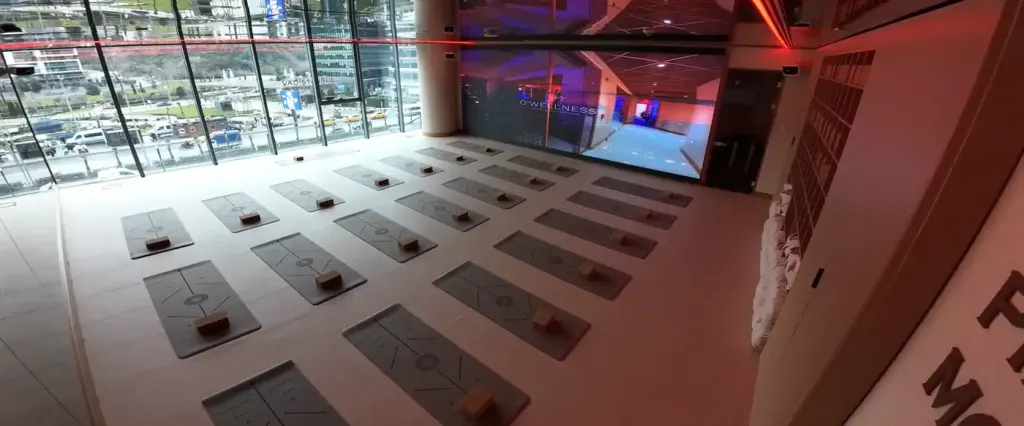
Motivation in Group Classes: Why Does the Community Effect Work?
Group training has a marked effect on motivation. We explain the psychological mechanisms behind the community effect and how to make the most of it.

Booty Class: The Aesthetic and Functional Benefits of Stronger Glutes
The glutes are the body's strongest muscle group. We explain Booty Class's structure, level variations, common mistakes and how to fit it into your week in Beytepe.
