
Thoracic Spine Mobility and Its Link to Shoulder Pain
Limited thoracic mobility can set the stage for shoulder pain. We look at exercises that improve upper-back range of motion and how they connect to shoulder health.
The source of tightness or pain in the shoulder is often not the shoulder itself but the thoracic spine just below it. Thoracic mobility describes the ability of the twelve vertebrae forming the rib cage to rotate and extend; stiffness in this area can make it harder for the shoulder joint to work through its normal range of motion. In this article we explain the mechanical link between the thoracic spine and the shoulder, exercises that improve mobility and how to carry them into daily life.
What is the thoracic spine, and why does it matter?
The spine has three main sections: the neck (cervical), the upper back (thoracic) and the lower back (lumbar). Because the thoracic region is attached to the ribs, it is naturally less mobile than the lumbar region; even so, it is expected to contribute significantly to rotation, side bending and extension. Today, sitting hunched over computers and phones for long periods can gradually reduce this area's natural capacity for extension and contribute to a more rounded upper back (increased thoracic kyphosis).
How does thoracic stiffness affect the shoulder?
Raising the arm overhead (shoulder flexion) relies not only on the shoulder joint but also on rotation of the shoulder blade and extension of the thoracic spine. If the thoracic spine is stiff and rounded forward, the shoulder joint has to produce more movement than usual as the arm rises. Over time, pushing the joint to its limits can lead to a feeling of impingement, extra load on the rotator cuff or chronic shoulder complaints. In sports movements such as swimming, padel, tennis and weightlifting, this compensation can become even more pronounced.
How can you assess your own thoracic mobility?
| Test | How to do it | Sign of restriction |
|---|---|---|
| Wall touch test | Back against the wall, arms raised overhead | Lower back arches excessively or arms cannot reach the wall |
| Seated trunk rotation | Arms crossed over the chest, trunk turned left and right | Noticeably less rotation on one side |
| Cat-camel position | On all fours, the back is moved up and down | Movement comes only from the lower back or neck while the mid-back stays still |
Key exercises to improve thoracic mobility
- Cat-cow: on all fours, round your back up as you exhale and open your chest forward as you inhale. 8-10 reps.
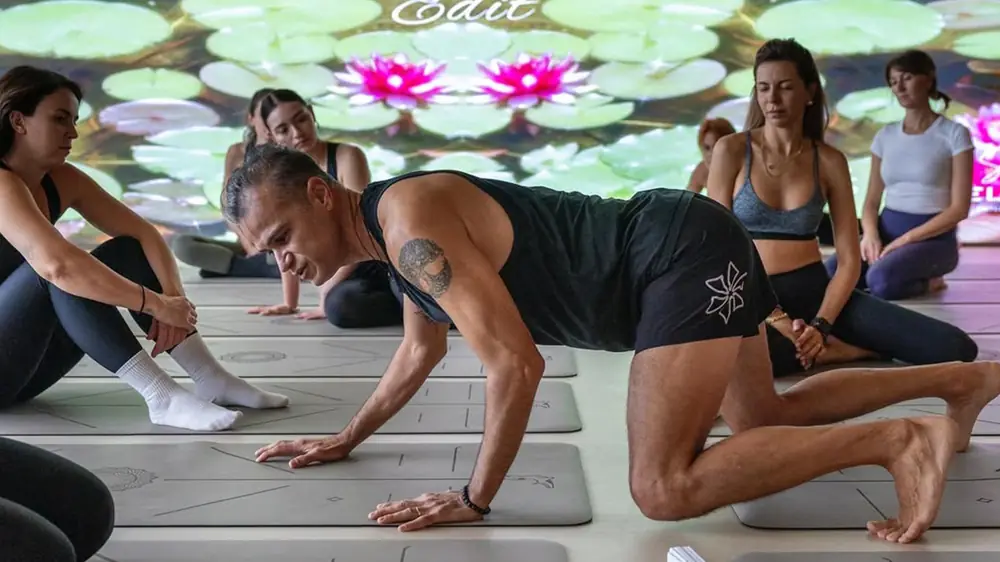
- Thread the needle: on all fours, slide one arm under the other to bring your shoulder and temple towards the floor, then open the same arm towards the ceiling as you rotate.
- Open book: lying on your side with the top knee bent forward, open your top arm across your chest to the opposite side, rotating your trunk.
- Foam roller extension: place the roller under your mid-back, hands behind your head, and gently lean back.
- Seated trunk rotation: sitting on a chair with arms crossed over your chest, rotate your trunk in both directions with control.
- Wall angel: with your back and head against the wall, slide your arms up and down while keeping them in contact with the wall.
- Reach through: on all fours, reach one arm across to the opposite side and rotate your trunk that way, then open the same arm to the ceiling.
Order of practice
An effective session starts with a low-intensity dynamic movement (cat-cow), continues with rotation exercises (thread the needle, open book) and finishes with extension work (foam roller, wall angel). A total flow of 12-15 minutes, done three to four times a week, usually makes a difference.
Level-based modifications
Beginners should keep the range of motion small and perform the foam roller extension especially carefully and slowly; the neck should not be left unsupported and the head should stay in a neutral position. Intermediate practitioners can add 2-3 second active holds at the end of rotation exercises. At an advanced level, these movements can be taken into a functional context by combining them with standing rotational work, such as light-weight trunk rotations. Anyone diagnosed with osteoporosis should avoid deep extension on the foam roller and consult their doctor.
Common mistakes
- Moving from the lower back or neck: compensating with neighbouring areas instead of isolating the thoracic region misses the real target.
- Neglecting the breath: not letting the movement deepen as you exhale can limit mobility gains.
- Focusing on one direction: working only rotation or only extension can lead to unbalanced development.
- Moving suddenly and fast: slow, controlled movement should be chosen over uncontrolled, rapid twists in the thoracic area.
- Practising inconsistently: short daily practice is usually more effective than one long session a week.
Who should be careful?
People with acute back pain, a history of fractures, osteoporosis or spinal surgery should consult their doctor or a sports physiotherapist before starting these exercises. If there is an acute shoulder injury (rotator cuff tear, history of dislocation), exercises involving shoulder movement should only be done under expert guidance. With symptoms such as dizziness, numbness or pain radiating down the arm, stop exercising and seek medical assessment.
Using equipment
Most of these movements need only a mat; a medium-density foam roller is useful for the extension exercise. A flat wall is enough for the wall-based movements. Mats and mobility equipment are available in the O'Soul studio and the functional area at O'Wellness Beytepe, so you do not need to bring your own.
Suggested weekly practice
| Day | Focus |
|---|---|
| Monday, Thursday | Full thoracic mobility flow (12-15 min) |
| Tuesday, Friday | Short desk rotations and wall angels (5 min) |
| Wednesday | Yoga or a group class |
| Weekend | Free movement, foam roller release |
Measuring progress
By repeating the wall touch test every week, you can track how close your arms get to the wall. In the seated rotation test, as the difference between the two sides shrinks, thoracic mobility can be said to be becoming more symmetrical. For people with shoulder pain, greater ease in everyday tasks such as brushing hair or reaching a high shelf is also an indirect sign of progress.
Combining with group classes
For those who want to work on thoracic mobility regularly, the Mobility & Stretching class includes movements that target this area directly. The flowing transitions and twisting poses of Vinyasa Yoga support thoracic mobility, while Balanced Yoga offers similar movements at a steadier pace. Those who also want to build upper-body strength can add the Total Body class to their programme. See the O'Wellness Beytepe weekly timetable for class times.
Breathing and thoracic mobility
Because the thoracic spine is directly connected to the ribs, it is also closely linked to breathing mechanics. Shallow breathing into the upper chest only can limit this region's capacity to expand, while a habit of deep diaphragmatic breathing allows the ribs to open sideways and backwards, indirectly supporting thoracic mobility. Letting the movement deepen as you exhale during mobility exercises makes it easier for muscles to relax and can calm the nervous system. This is why the coordination of breath and movement is especially emphasised in thoracic work in yoga practice.
Posture habits and long-term effects
Everyday posture habits directly affect the long-term movement capacity of the thoracic spine. Habits such as sitting hunched in front of a screen, letting the head drop forward while looking at a phone (sometimes called "text neck") and always leaning on the same side when seated can, over time, contribute to increased kyphosis and one side becoming stiffer than the other. While eliminating these habits completely is not realistic, noticing your posture during the day and changing position at regular intervals reinforces the effect of mobility work. Raising the screen to eye level and adjusting the chair's back support correctly are also simple but effective measures.
Thoracic mobility and strength training
Thoracic mobility matters not only for flexibility but also for strength training performance. In overhead movements such as pull-ups or the overhead press, for example, it can be harder for the shoulder joint to work through its full range safely without adequate thoracic extension. A short thoracic mobility routine before lifting can support both performance and the shoulder's safe working range. Reformer Pilates sessions are also a practical way to work thoracic extension in a safe, supported position; back-supported movements on the carriage open the spine in a controlled way while also training trunk stabilisation. In the O'Wellness Beytepe Reformer studio, equipped with Balanced Body machines, sessions are held with a maximum of 6-8 people.
Bringing it into daily life
For mobility work to deliver lasting benefits, it is important to apply it consciously not only in training but also in everyday movement. For example, turning your whole body instead of slightly rotating your trunk when reaching for something on a high shelf leaves the thoracic spine passive. Consciously remembering to rotate from the trunk in simple daily movements makes the mobility you have gained functional. Moments such as looking back over your shoulder while driving or turning your trunk while hanging laundry are natural opportunities to put this into practice. Over time, these small moments of awareness add up, helping the thoracic spine play a more active role in daily movement and reducing the compensatory load on the shoulder joint.
Frequently asked questions
Will thoracic mobility completely resolve shoulder pain?
Limited thoracic mobility can be one of the factors contributing to shoulder pain, but it may not be the only cause. With chronic or severe shoulder pain, it is important to be assessed by a doctor or sports physiotherapist.
Can I do these exercises at work, at my desk?
Seated trunk rotation and wall angels are easy to do in the office; cat-cow and foam roller exercises require floor space.
How often should thoracic mobility exercises be done?
Regular practice of 10-15 minutes, three to four times a week, usually makes a noticeable difference; short breaks during the day also help.
Are there classes for thoracic mobility and shoulder health in Beytepe?
Yes. At O'Wellness Beytepe, Mobility & Stretching and yoga classes include movements for this area, and a one-to-one assessment with a sports physiotherapist can also be arranged.
Can thoracic mobility be trained without a foam roller?
Yes. Movements such as cat-cow, thread the needle and open book need no equipment and offer an effective starting point.
Get in touch for a mobility plan that supports your shoulder and back health; let us build your programme together during your free trial session.
Related posts

Yoga Poses for Neck and Shoulder Tension
How can yoga ease neck pain? We walk you step by step through safe yoga poses for neck and shoulder tension caused by desk-bound life.
How Does Flexibility Improve? Static, Dynamic and PNF Stretching Compared
How can flexibility be developed? Static, dynamic, ballistic and PNF stretching, when to use each, and a sample weekly program.
Shoulder Stability in Yoga: Protecting the Shoulders in Downward Dog, Plank and Chaturanga
In vinyasa flows the shoulders bear load hundreds of times. We explain how to protect and strengthen the shoulders with scapular control and correct alignment.
