
The First 4 Weeks for Gym Beginners: What to Do and What to Avoid
Don't spend your first month wandering or overdoing it. A week-by-week starter guide from the O'Wellness Beytepe coaches.
You have started your membership and picked your locker, yet the moment you step onto the gym floor you have no idea where to begin? Most gym beginners spend their first four weeks either pushing far too hard or drifting aimlessly from machine to machine, and both paths drain motivation fast. In this article we share how the first month should ideally unfold, which mistakes come up most often and the concrete steps we recommend to new members at O'Wellness Beytepe.
Week one: rest your ego, not your body
The most common misconception among beginners is that they must try every piece of equipment on day one. In reality, the goal of the first week is building a habit, not performance. Showing up, getting to know the equipment and learning the correct form of the basic movements are the only tasks this week. Keep the loads light and focus on how your nervous system learns technique rather than on your muscles. Two to three sessions of 30–40 minutes are more than enough in week one. In each session, aim to learn 5–6 fundamental movements (squat, hinge, push, pull, lunge, core) for two sets with a low load.
The 6 most common mistakes
- Attempting your heaviest load on day one. Muscle soreness (DOMS) peaks within 48–72 hours; overloading amplifies it so much that you may stay away from the gym for a week.
- Having no program at all, let alone a structured split. Randomly chosen exercises make progress impossible to measure.
- Rushing through or skipping the warm-up. Lifting heavy with cold muscles noticeably raises the risk of injury.
- Doing only cardio and avoiding strength work. Because muscle mass is critical for metabolism and posture, strength training should have a place from the very first week.
- Trying to overhaul nutrition, sleep and training all at once. Too many changes reduce sustainability; progress step by step.
- Training alone and never having your technique checked. Feedback from a coach in the early weeks prevents bad habits that could otherwise last for years.
Week two: consolidate the fundamental movement patterns
In the second week the load can rise slightly, but technique is still the priority. Concentrate on the six fundamental movement patterns (squat, hinge, push, pull, lunge, core/carry); they form the skeleton of every program you will build later. Staying in the 10–12 rep range per set at this stage helps technique settle and allows your joints to adapt at a safe pace. Mild muscle soreness after training is natural; sharp joint pain is not, and it means you should stop the movement and consult your doctor if necessary.
Week three: increase volume gradually
Your body has started to get used to the basic movements. In week three you can add one set per exercise or raise the load by 2.5–5 percent. This is also the time to review your weekly frequency: moving from two to three days a week stimulates each muscle group more often and accelerates progress for beginners. Whether you should choose a full-body or a split program depends on how many days you can train; for someone training 2–3 days a week, full body usually delivers better results.
Week four: first measurement and review
The end of week four completes your first month, and it is time to assess progress objectively. The scale alone can be misleading; look instead at three indicators: the technical quality of your basic movements, the increase in reps you can perform with the same load, and your overall energy and sleep quality. If you see positive change in these three areas, the program is working. At O'Wellness Beytepe we recommend scheduling a personal training assessment session at the end of the first month; it includes a movement screen and sets out your program for the next 8 weeks.
Sample weekly plan (first 4 weeks)
| Week | Frequency | Focus | Sets × Reps |
|---|---|---|---|
| 1 | 2–3 days | Learning technique | 2×10–12, light load |
| 2 | 2–3 days | Consolidating movement patterns | 2–3×10–12 |
| 3 | 3 days | Increasing volume | 3×10–12 |
| 4 | 3 days | Review + slight load increase | 3×8–12 |
Don't neglect warm-up and recovery
Open every session with a 5–8 minute dynamic warm-up: light cardio, hip circles, arm circles and a few low-load reps of your first exercise. After training, 5 minutes at an easy pace plus light stretching supports recovery. Don't overlook sleep and nutrition during this period either; about 1.6 g of protein per kilogram of body weight per day supports muscle adaptation. For more on recovery, see the recovery articles on our blog.
Learning the equipment and gym etiquette
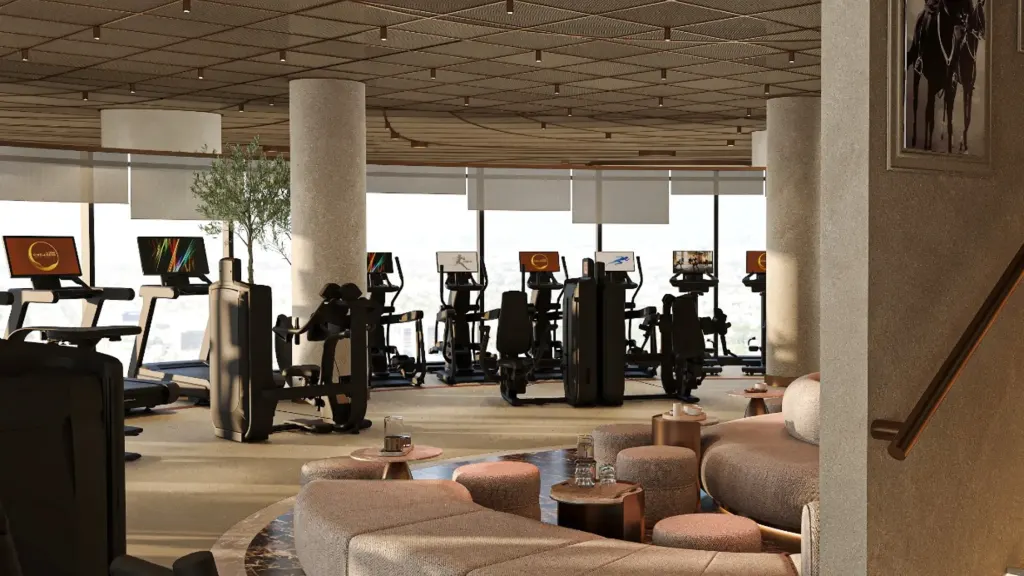
Some beginners never approach the machines for fear of using them wrongly, while others avoid the free-weight area. Getting to know both during the first month is worthwhile: dumbbells, kettlebells, barbells and machines each offer different advantages. Machines fix the path of movement and therefore build confidence while you learn technique; free weights work your balance and stabilising muscles harder. Gym culture also has simple rules: putting weights back after use, not holding on to equipment for long periods and letting others work in between your sets. The strength and cardio area and the functional zone at O'Wellness Beytepe let you experience both worlds, and these small habits improve everyone's experience.
Keeping motivation alive in the first 4 weeks
The most common reason motivation fades is unrealistic expectations. Instead of expecting visible muscle gain in the first month, it is far healthier to treat technical improvement, changes in energy and the formation of a training habit as your measures of success. Setting small goals (such as coming to the gym three times this week or reaching proper depth in the goblet squat) keeps motivation concrete and achievable. Finding a training partner or joining group classes are also effective ways to stay consistent; a sense of social accountability noticeably increases adherence compared with training alone.
Common physical responses in the first month
Some responses in the first weeks are normal and no cause for concern: temporary muscle soreness, mild fatigue, changes in appetite and improved sleep. On the other hand, dizziness, chest pain, shortness of breath or sharp joint pain are not normal; in such cases training should be paused and a doctor consulted if necessary. People with cardiovascular conditions, uncontrolled blood pressure or a chronic illness should get medical clearance before starting a program.
Group classes or training on your own?
Group classes are valuable for beginners in terms of both motivation and correct technique; learning movements with a coach is safer than training alone. The Total Body and Crunch & Core classes in the O'Rise studio at O'Wellness Beytepe are designed to teach the fundamental strength patterns, and you can also add core and posture work in the Reformer Pilates studio. For the general principles of strength training, we recommend reading the strength training guide on our blog.
Technical details of the basic movements
Each movement you learn in the first 4 weeks has its own technical nuances. In the squat, the knees should not travel past the toes, the heels should stay on the floor and the natural curve of the lower back should be maintained. In hinge movements, the knees stay slightly bent while the movement starts at the hips and the back stays flat. In pushing movements, keep the shoulders away from the ears and the wrists in a straight line. In pulling movements, the shoulder blades should take part rather than relying on arm strength alone. Learning these four patterns correctly is the solid foundation of every program you will build later.
Level-based variations
Not everyone starts from the same level, so each movement comes in different degrees of difficulty.
| Movement pattern | Easy variation | Standard variation | Advanced variation |
|---|---|---|---|
| Squat | Sit-to-stand from a chair | Goblet squat | Back squat |
| Hinge | Glute bridge | Romanian deadlift (dumbbell) | Conventional deadlift |
| Push | Wall or bench incline push-up | Kneeling push-up | Standard push-up / bench press |
| Pull | Resistance band row | Seated cable row | Lat pulldown / pull-up |
Throughout the first four weeks, performing each movement at the right level with clean technique is far more valuable than jumping to advanced variations early. Once technique is established, difficulty should be raised step by step; this is the most basic application of the progressive overload principle.
Preparation checklist for the first 4 weeks
- Comfortable workout clothes that let you move freely and supportive training shoes.
- A water bottle; drinking regularly during training offsets fluid lost through sweat.
- A light, carbohydrate-focused meal 1–2 hours before training.
- A notebook or phone app to record your sets, reps and loads.
- A towel; it is required both for hygiene and under the equipment rules at O'Wellness Beytepe.
Who needs a different approach in the first month?
People with chronic lower back, knee or shoulder problems, those who are pregnant, those recovering from surgery and those with cardiovascular conditions should consult their doctor before starting the standard four-week plan and, ideally, be assessed by a sports physiotherapist. For beginners over 60, it is safer to prioritise balance, range of motion and low-intensity patterns over load in the first week. For these groups the program should be personalised around movement quality rather than load.
How should you measure progress?
In the first four weeks, progress does not always mean lifting heavier. Track these questions: can you perform the same movement with more control and through a full range of motion, do you complete the same load with less fatigue, is your post-session recovery getting shorter and is your daytime energy rising? Positive change in these four areas is the most reliable sign that your body is adapting well. Recording your sets, reps and loads regularly allows a clear comparison at the end of week four.
Why nutrition and sleep are decisive in the first month
The stimulus created by training only turns into repair with adequate protein, total calories and sleep. Throughout the first four weeks, about 1.4–1.6 grams of protein per kilogram of body weight per day supports muscle adaptation and recovery. Sleeping less than 7 hours noticeably lowers both performance and motivation. Rather than radically changing your diet during this period, adding quality protein sources to your meals is a more sustainable route; for detailed support you can consider our dietitian service.
Practical notes for beginners in Beytepe
Located in the Yaka Beytepe complex, O'Wellness Beytepe is just a few minutes from Hacettepe University's Beytepe campus and the Çayyolu–Ümitköy corridor, which makes it easy to build a regular habit after work or classes; the complex car park makes access practical too. The strength and cardio area and the O'Rise studio are good starting points for beginners. The club is open 06:00–23:00 on weekdays and 08:00–23:00 at weekends, and a free facility tour and trial session let you see the environment and equipment before you decide.
Balancing cardio and strength training
Some beginners who want to lose weight head straight for the cardio machines from the first month, while others only lift weights and never challenge their cardiovascular system. The ideal approach in the first four weeks is to devote most of the weekly plan to strength training and add 1–2 moderate cardio sessions of 15–20 minutes. This balance supports heart health while preventing cardio fatigue from holding back strength gains. Placing cardio on a separate day from strength training helps you get more out of both.
Flexibility and mobility work in the first month
Neglecting flexibility and mobility while focusing on strength can lead to technical limitations later on. Restricted movement in the hips, shoulders and chest in particular makes it harder to squat and push with correct form. A weekly 20–30 minute mobility session raises training quality and improves everyday posture. The Mobility & Stretching classes in the O'Soul studio suit this purpose well; hip and chest openers are especially helpful for those who spend long hours at a desk.
What happens after 4 weeks?
By the end of the first month you should have learned the basic movements and built a habit of showing up regularly. From week five, a program usually develops in one of two directions: either weekly frequency increases (from two days to three or four), or load and volume rise gradually on your current exercises. At this point the program can become more specific depending on your goal (general strength, muscle mass, fat management). Reviewing your program with a coach during this transition noticeably increases the return from the next 8 weeks.
Emotional and mental adjustment in the first 4 weeks
Adapting to a new environment is as much a mental process as a physical one. Feeling uncomfortable on the gym floor, worrying about using equipment wrongly or comparing yourself with other members are common in the first weeks. Knowing that these feelings are normal and will ease over time reduces the likelihood of quitting. Joining a small group or working with a coach makes this adjustment considerably easier. Remember that everyone in the gym was once a beginner.
Questions to ask yourself at the end of the first month
When four weeks are complete, ask yourself: Can I perform the basic movements confidently and with correct form? Can I sustain my weekly training frequency, or am I struggling? How have my energy and sleep quality changed? What should my goal be for the next four weeks: more frequency, more load, or continuing with the current structure? Honest answers to these questions are the most solid way to shape your second month's program.
Frequently asked questions
Should I come every day in the first week?
No, 2–3 days a week is enough in the first week. Your muscles and joints need time to adapt to the new stimulus; training the same muscle group hard on consecutive days hinders recovery.
Is muscle soreness normal, and when should I worry?
Mild to moderate muscle soreness (DOMS) lasting 1–3 days after training is normal. Sharp pain coming from inside a joint or sudden pain that worsens with movement is not; in that case pause training and consult your doctor.
Should I train to lose weight or to build muscle?
You don't need to choose in the first four weeks; both goals are built on the same basic strength training and consistent nutrition. Goal-specific adjustments come once technique is established.
Is there special support for beginners at O'Wellness Beytepe?
Yes, we offer a free facility tour and trial session before you join, and in the first weeks you can ask our coaches for a check of your basic movements.
What if I see no results after 4 weeks?
Four weeks is a habit-building period; noticeable physical change usually appears in 8–12 weeks. At this point it makes sense to review your program with a coach.
Plan your free facility tour and trial session at O'Wellness Beytepe in Yaka Beytepe to spend your first four weeks with the right plan.
Related posts
How to Bench Press: Setup, Technique and Safety Guide
Setup, grip, elbow angle and safety planning for the bench press: a step-by-step way to learn the lift while staying kind to your shoulders.

Body Composition Analysis: Body Fat, Muscle Mass and Measurement Methods
Why body composition analysis is more reliable than a scale, and which methods measure body fat and muscle mass: a guide to measuring and interpreting correctly from O'Wellness Beytepe.

Kettlebell Training: A Guide to the Swing, Clean and Turkish Get-Up
A practical guide to the correct technique and benefits of the kettlebell swing, clean and Turkish get-up, with a four-week starter program.
