
Bodyweight Training: How to Build Strength Without Equipment
Can you build strength without equipment? A bodyweight training guide covering fundamental movement patterns, ways to increase difficulty and progression protocols.
Not having equipment is one of the most common excuses for never starting strength training. Yet a well-planned bodyweight programme can be as effective as dumbbells or a barbell for building strength and muscle. In this article we cover the movements that form the foundation, how to increase difficulty step by step without equipment, and concrete programmes you can use at home, at the office or while travelling.
Does bodyweight training really work?
What drives muscle growth is exposing the muscle to enough mechanical tension at sufficient intensity and volume; whether that tension comes from a dumbbell or your own body is secondary. In bodyweight movements, difficulty can be increased by lengthening the lever arm, working unilaterally, slowing the movement down or reducing points of contact with the floor. That is why the idea that "equipment-free training is light training" is wrong; with the right progression knowledge, bodyweight work can challenge even advanced athletes.
Six fundamental movement patterns and their equipment-free versions
| Pattern | Basic version | Advanced version |
|---|---|---|
| Squat | Bodyweight squat | Pistol squat (single leg) |
| Hinge | Glute bridge | Single-leg Romanian deadlift (bodyweight) |
| Push (horizontal/vertical) | Push-up | Archer push-up, pike push-up |
| Pull | Door frame row / towel row | Pull-up, one-arm pull-up progression |
| Lunge | Split squat | Bulgarian split squat, jumping lunge |
| Core / carry | Plank | Long-lever plank, hollow body hold |
Five ways to increase difficulty
- Lengthening the lever: Moving your hands slightly forward or raising your feet in a push-up increases resistance.
- Working unilaterally: Training on one leg instead of two (the road to the pistol squat) effectively doubles the load.
- Slowing the tempo: Lowering for 4 seconds and rising in 1 makes the same movement much harder.
- Adding isometric pauses: Holding for 2-3 seconds at the hardest point, for example midway through a push-up, increases muscle tension.
- Moving to explosive variations: Clap push-ups or jump squats add a power component to the programme.
The push-up progression ladder: a worked example
The push-up is not an "I can or I can't" movement but a ladder you climb rung by rung. The sequence below shows the path from beginner to advanced; once you comfortably complete 3 sets × 10-12 reps on one rung, move on to the next.
- Wall push-up
- Push-up on a raised surface (table, bench)
- Knee push-up
- Standard push-up
- Feet-elevated (decline) push-up
- Archer push-up (shifting weight onto one arm)
- One-arm push-up progression
The pull-up: preparing for the hardest bodyweight move
In bodyweight training, pulling strength develops more slowly than pushing strength because the back muscles have to lift the whole body. If you have no doorway bar at home, you can train your back with towel rows looped around a sturdy door handle or with band-assisted row variations. Once you have a bar, progress in this order: a 20-30 second dead hang, negative pull-ups (getting help to the top and lowering slowly) 3×5, band-assisted pull-ups and finally full pull-ups.
Sample weekly programme: equipment-free full body
| Day | Content |
|---|---|
| Day 1 | Push-up 3×AMRAP*, split squat 3×10, plank 3×30 s, glute bridge 3×15 |
| Day 2 | Pistol squat progression 3×5 (each leg), towel row 3×12, pike push-up 3×8, hollow hold 3×20 s |
| Day 3 | Jump squat 3×10, archer push-up progression 3×6, single-leg glute bridge 3×10, side plank 3×20 s |
*AMRAP ("as many reps as possible"): as many repetitions as you can do without breaking form.
The limits of bodyweight training
Bodyweight training is versatile but not limitless. Building maximal strength, especially in the lower body at the level of heavy squats or deadlifts, is difficult without external resistance; athletes who reach an advanced level usually continue progressing with tools such as dumbbells, kettlebells or resistance bands. This does not make equipment-free training worthless; for many people it offers an excellent start and a sustainable base, which can be supported with extra equipment for advanced goals.
Common mistakes
- Sticking to the same rep count: Repeating the same number of push-ups without progression leads to a plateau; apply one of the methods for increasing difficulty.
- Sacrificing technique for speed: Fast, half-range reps are less effective than slow, controlled, full-range ones.
- Focusing only on pushing: Because push-ups and squats are easy to access, pulling and hinge movements can be neglected, which creates imbalances.
- Skipping the warm-up: Even without equipment, a warm-up is essential for joint mobility and muscle activation.
How do you measure progress?
In equipment-free training, progress is measured not by weight lifted but by rep count, variation difficulty and tempo control. For example, someone who did 3×8 knee push-ups four weeks ago and can now do 3×10 standard push-ups has made clear progress. Testing the same movements each week under similar conditions and writing down the results provides objective tracking.
Combining bodyweight training with the club
Training without equipment at home or on the road maintains consistency, while the club environment provides extra resistance tools, variety and professional feedback. Training with more variety at the club on weekdays and doing bodyweight sessions at home at the weekend creates a practical, sustainable balance for many members.
Supporting bodyweight training at O'Wellness Beytepe
For those who want to give direction to their bodyweight work with the facilities at our Beytepe club, Vinyasa Yoga and Mobility & Stretching classes in the O'Soul studio develop body control and range of motion, while O'Hiit, Tabata and Crunch & Core classes in the O'Rise studio deliver high-intensity bodyweight circuits in a structured way. The TRX in the functional area is ideal for learning bodyweight pulling. If you want to speed up progress on advanced moves such as the pull-up or pistol squat, personal training can build a programme tailored to you.
Consistency when travelling and during busy periods
The greatest practical advantage of bodyweight training is that it needs neither equipment nor a gym. Being doable in a small space such as a hotel room, an empty meeting room at the office or a corner of a park makes it the easiest way to keep training consistent for people who travel often or work long hours. This flexibility makes it easier to maintain consistency, the most critical element of steady strength development.
Lower-body strength without equipment: the pistol squat journey
The pistol squat, also known as the single-leg squat, is one of the hardest lower-body moves in bodyweight training; it requires balance, flexibility and strength to develop together. Progressing step by step rather than attempting it outright gives better results for both safety and motivation.
- Controlled sit-to-stand on a chair with weight on one leg (3×8 each leg)
- Single-leg squat on a raised surface (box, step), gradually increasing depth
- Band-assisted pistol squat (the band is anchored to a fixed point for support)
- Slow-lowering (eccentric) pistol squat: descending over 4-5 seconds and standing up with help
- Full pistol squat
This process usually takes 8-16 weeks; people with limited flexibility should work on ankle and hip mobility in parallel.
Advanced equipment-free core movements
For those who want to go beyond basics such as the plank and dead bug, the hollow body hold, L-sit progression and dragon flag significantly increase core strength. Because these moves are very demanding, they should not be attempted until basic core stability is established (a 60-second plank, a fully controlled dead bug). A gradual approach applies here too: the hollow body hold starts with bent knees and becomes harder over time as the legs are extended.
The role of flexibility and mobility
Many advanced movements, such as the pistol squat, deep push-ups and archer variations, require adequate joint range of motion. If hip, shoulder or ankle mobility is limited, the movement cannot be done through full range even when strength is sufficient. Two 10-minute targeted mobility sessions a week (hip circles, shoulder CARs, ankle dorsiflexion stretches) speed up the move to advanced exercises and reduce injury risk.
Practical ways to measure equipment-free progress
Without dumbbells, a few simple tests can answer the question "how much stronger have I got?": a max-rep push-up test every four weeks, plank time, dead hang time and your stage in the pistol squat progression. Repeating these tests under the same conditions (same time of day, similar fatigue) gives comparable results. If there is no progress, the programme should be reviewed and one of the difficulty methods introduced.
Nutrition and recovery: the same rules apply
Whether you train with bodyweight or weights, nutrition and sleep are equally important for muscle growth and strength gains. Adequate protein (roughly 1.6-2.0 g per kilogram per day, depending on individual needs), total calories suited to your goal and a regular 7-9 hours of sleep are the basic conditions for bodyweight programmes to deliver. As training volume rises, so does the need for recovery; give each muscle group at least one full rest day a week. Poor sleep slows muscle repair and, by making technical focus harder, can indirectly raise injury risk. Our dietitian service can help you with a personal plan.
Frequently asked questions
Can you build muscle with bodyweight training?
Yes, especially for beginners and up to an intermediate level. When difficulty is increased gradually with unilateral movements, tempo control and isometric pauses, enough stimulus for muscle growth can be provided.
How many days a week can you train without equipment?
You can train 3-4 days a week, allowing muscle groups enough rest, that is, without working the same area hard on two consecutive days.
I can't do a pull-up. Is there an alternative?
Yes. You can gradually build back strength with progression steps such as towel or band-assisted rows, negative pull-ups and dead hangs; at the club, TRX is also a good starting point.
Which classes at O'Wellness Beytepe suit bodyweight training?
O'Hiit, Tabata and Crunch & Core focus on bodyweight-based strength and endurance, while Vinyasa Yoga and Mobility & Stretching focus on control and range of motion.
When should I move from bodyweight to dumbbells?
When you start doing advanced variations such as one-arm push-ups or pistol squats comfortably, or when your goal is maximal strength, adding external resistance is a sensible next step.
Take advantage of our free trial session to support your bodyweight strength development with a structured programme.
Related posts

An Efficient 45-Minute Workout Plan for Busy Professionals
A strength program that trains the whole body in 45 minutes, planned minute by minute from warm-up to cool-down and built around a busy work schedule.

Setting Measurable Goals in Fitness: SMART Goals and a 90-Day Plan
A practical step-by-step guide to using the SMART framework, building a 90-day plan and measuring progress when setting fitness goals.
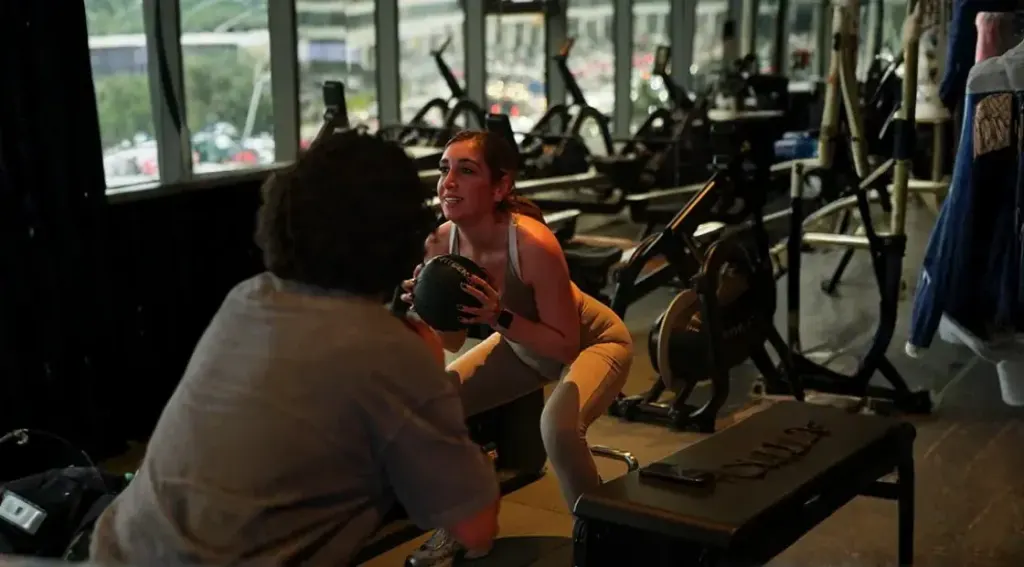
Weight Training for Women: Common Myths Explained
Will lifting make me bulky, and isn't cardio enough? We calmly address the most common beliefs about weight training for women.
