
What Is Reformer Pilates? Benefits, Who It Suits and a First-Session Guide
How the reformer works, how it differs from Mat Pilates, its scientific benefits, who it suits and what to expect in your first session at O'Wellness Beytepe.
Reformer Pilates has become one of the fastest-growing exercise methods in Ankara in recent years. Behind the sliding, spring-loaded machine you see on social media lies a century-old movement philosophy and an ever-growing body of scientific literature. In this guide we explain step by step what Reformer Pilates is, how it works, who it suits and what to expect in your first session at the O'Wellness Beytepe Reformer studio.
What is Reformer Pilates?
The reformer is an exercise machine designed by Joseph Pilates in the 1920s: a sliding platform (carriage) on a bed-like frame, springs of varying resistance, a footbar, shoulder rests and straps. Exercises are performed by pushing, pulling or holding the carriage against the springs. The springs provide both resistance and support: a heavy spring makes a movement harder, while in some exercises a light spring is more demanding because it requires more control. This dual nature makes the reformer a unique tool for both rehabilitation and advanced strength work.
The six core principles of the Pilates method also apply on the reformer: centring (movement initiated from the core), concentration, control, precision, breath and flow. The reformer makes these principles tangible through the machine's feedback: if the carriage wobbles, control has been lost; if the spring snaps back noisily, the movement is not precise enough.
Reformer vs Mat Pilates
Mat Pilates is done on the floor using only body weight, while Reformer Pilates uses spring resistance and a moving platform. In practice this means:
- Scalable load: On the reformer, the same exercise can be made easier for a beginner or harder for an athlete through spring choice. On the mat this range is narrower.
- Support: The straps and carriage let people with back or neck problems safely perform movements they could not do on the mat.
- Repertoire: The reformer offers more than 250 exercise variations, with standing, seated, side-lying and kneeling work all possible.
- Feedback: The moving carriage instantly reveals asymmetries and compensations, so the instructor can correct them quickly.
The two methods are complementary rather than competing. At O'Wellness Beytepe the weekly schedule includes both Mat Pilates in the O'Soul studio and Reformer Pilates in the Reformer studio; for many people the ideal combination is two Reformer sessions and one Mat session a week.
Scientifically supported benefits
1. Core strength and spinal stability
Pilates exercises target the deep abdominal muscle, transversus abdominis, and the multifidus muscles that wrap the spine. Numerous randomised controlled trials have shown that Pilates reduces pain and functional limitation in people with chronic low back pain. The reformer's spring support makes it easier to work these muscles within a pain-free range.
2. Posture and alignment
Long hours at a desk lead to rounded shoulders, increased thoracic kyphosis and weak glute activation. Reformer exercises help reverse these patterns through spinal articulation, shoulder blade stability and hip extension. People who attend regularly typically report a noticeable change in their posture within six to eight weeks.
3. Flexibility and range of motion
The reformer lengthens muscles under load, providing eccentric work. Compared with static stretching, this delivers more lasting gains in range of motion and is especially effective for the hamstrings, hip flexors and chest muscles.
4. Balance, coordination and body awareness
Working on a moving platform constantly stimulates proprioception, the body's ability to sense its position in space. This helps reduce injury risk in athletes and fall risk in later life.
5. Muscular endurance and body composition
The reformer on its own is not a high-calorie cardio workout, but by increasing muscle mass and movement quality it boosts the effectiveness of other training. If weight management is the goal, combining it with O'Ride Cycle or HIIT classes and a nutrition plan is recommended.
Who is it for?
- Beginners: Beginner-level classes and one-to-one sessions are designed for people starting from scratch.
- People with back, neck or shoulder pain: You can start safely with your doctor's approval and an assessment by our Sports Physiotherapist.
- Those who are pregnant or postnatal: In a one-to-one format, with trimester-appropriate modifications and medical approval.
- Athletes: Rotational power, hip stability and shoulder health for golfers, tennis and padel players and runners. It is also a great complement for those who play on the O'Padel Beytepe courts in the same complex.
- Over 50s: Strength, balance and bone health with low joint load.
- Men: The reformer is not a "women's sport"; it is one of the most efficient tools for strength athletes to address mobility and core gaps.
The O'Wellness Beytepe Reformer studio
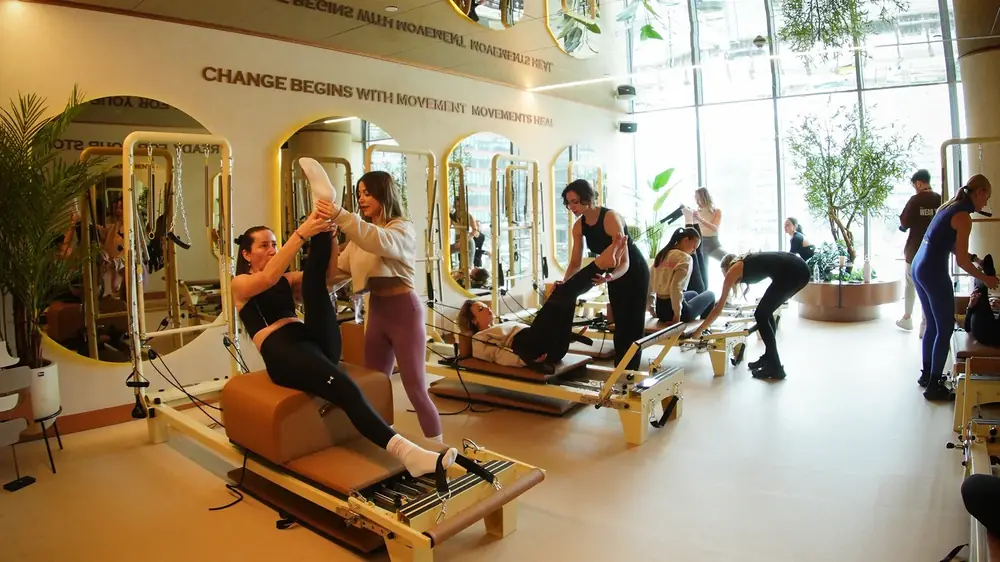
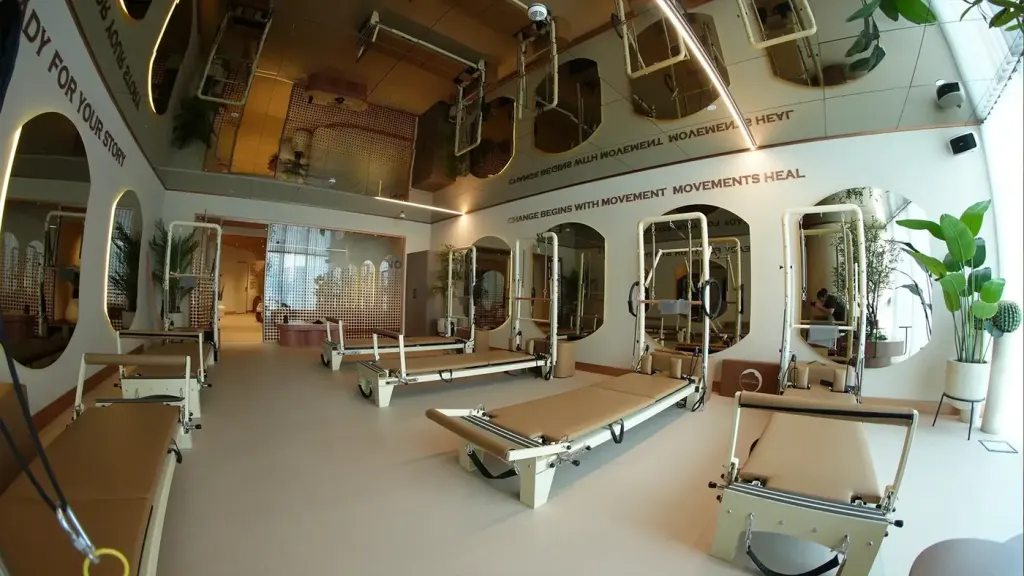
Our studio in the Yaka Beytepe complex uses Balanced Body reformers. Each group session runs with a maximum of 6-8 people, so the instructor can follow every participant's alignment and breathing individually. Classes are planned across morning, midday and evening slots within our opening hours of 06:00-23:00 on weekdays and 08:00-23:00 at weekends. Alongside group classes, Private Reformer Pilates sessions are also available. See our Reformer Pilates page for details.
What to expect in your first session
- Short consultation (about 5 minutes): Your instructor asks about your health history, injuries and goals, and a health questionnaire (PAR-Q) is completed.
- Machine introduction (about 5 minutes): The springs, footbar, straps and safety rules are explained, and you learn the spring colour codes.
- Footwork series (about 10 minutes): The fundamental series of pushing the footbar while lying on your back; leg alignment and breathing rhythm are established here.
- Core and upper body (about 20 minutes): The hundred, strap arm series and spinal articulation.
- Stretch and close (about 10 minutes): Hip and hamstring stretches and breathing work.
What to wear? Close-fitting leggings and a top that will not slip, plus non-slip Pilates socks. Avoid baggy shorts and clothes with zips. What to bring? Water and a small towel are enough; the reformer and other equipment are provided by the studio.
Common mistakes and how to avoid them
- Holding your breath: Exhale on effort and inhale during preparation. Holding your breath switches off the core.
- Pulling with the neck: In abdominal exercises, lift by raising the ribcage, not by pulling your head with your hands.
- Letting the spring slam back: The carriage's return is half the movement; do not let go of control.
- Assuming a heavier spring is better: In some exercises a light spring is harder; use the spring your instructor recommends.
How many sessions a week?
Two to three Reformer sessions a week is ideal for clear progress. Beginners can start with one session a week and move up to two within a couple of weeks. Placing strength, cycle or yoga classes between Reformer days balances the week; see our group classes and weekly schedule pages for a sample weekly plan.
Reformer springs and equipment in detail
The heart of the reformer is its spring system. Balanced Body machines usually have several springs of different resistance; colour codes vary by manufacturer, but the logic is universal: the lightest spring on its own gives the least resistance, and all the springs together give the most. However, the equation "heavy spring equals strong movement" is not always true. Because of counter-resistance, a light spring stabilises the carriage less in some exercises, which forces the core muscles to work harder. For example, in the footwork series a heavy spring targets the leg muscles, while in strap arm series a light spring challenges the shoulder stabilisers and core far more.
The carriage itself runs on bearings with almost zero friction, so control of the movement depends entirely on the user's muscle activation. The footbar has several height settings, and changing it alters the hip and knee angles to direct the same exercise to different muscle groups. The shoulder rests protect the spine and neck while transferring force, especially in supine pushing exercises. The straps, attached at the ankle or wrist, require you to keep the core stable while the arms and legs move freely, which is the foundation of functional strength. All these components are adjusted by your instructor to your height and goals at the start of each session; changing spring or bar settings on your own is not recommended.
Reformer Pilates by level: beginner, intermediate, advanced
Beginner level
In the first four to six weeks your aim is to learn the movement patterns and synchronise breath with movement. During this period, basic footwork, a modified hundred and spinal articulation exercises are practised with medium and light springs rather than heavy ones. The goal is alignment, not speed. One or two sessions a week are enough.
Intermediate level
Once the basic repertoire is learned, usually after six to ten sessions, strap combinations for arms and legs, side-lying hip series and single-leg exercises that require balance are added. At this level spring resistance is changed deliberately according to the purpose of the exercise. Two to three sessions a week are recommended.
Advanced level
At advanced level, standing work on the carriage, asymmetric series requiring full strap control and long combinations linked in a flow come into play. With regular attendance this level is usually reached within three to four months; athletes at this stage focus on rotational power and unilateral stability.
A sample eight-week Reformer Pilates programme
The programme below is a general framework; talk to your instructor for a personalised plan. If you have any doubts about your health, consult your doctor before starting.
| Week | Session frequency | Focus | Complementary class |
|---|---|---|---|
| 1-2 | Once a week | Basic footwork, breathing, alignment | None |
| 3-4 | Twice a week | Core activation, spinal articulation | Mat Pilates (once a week) |
| 5-6 | 2-3 times a week | Strap arm and leg series, balance | Deep Stretch Yoga (once a week) |
| 7-8 | 3 times a week | Flowing combinations, challenge with light springs | O'Ride Cycle (once a week, cardio support) |
Special conditions and age adaptations
The spring-assisted, scalable nature of Reformer Pilates makes it adaptable to different physical needs; however, in every special situation you should first consult your doctor and inform your instructor.
- Pregnancy: Especially in the second and third trimesters, positions that keep you on your back for long periods are avoided and movements that increase intra-abdominal pressure are removed. Working one-to-one with an instructor experienced in prenatal Pilates is recommended; your obstetrician's approval is essential.
- Chronic low back pain: Flexion-heavy movements are limited and core stabilisation in a neutral spine is prioritised. An initial assessment with our Sports Physiotherapist is ideal.
- Osteoporosis or low bone density: Movements with excessive spinal flexion and rotation are avoided; a low-impact programme focused on extension and strength is preferred. Medical approval is required.
- After hip or knee replacement: With physiotherapist approval, progress is made by gradually increasing range of motion and controlling load.
- Athletes and performance goals: Advanced protocols built on rotational power, unilateral stability and eccentric control can be used; talk to your instructor or our Athletic Performance team about sport-specific modifications.
- Over 50s and those at risk of falls: Balance and proprioception work is prioritised, and advanced standing exercises are added gradually.
Who it is not suitable for, or who should take care
Although Reformer Pilates is largely a safe and adaptable method, in some cases medical assessment is essential first or the method should be postponed temporarily:
- People with uncontrolled cardiovascular conditions (without medical approval).
- Those with an acute disc herniation, a recent spinal fracture or in the early stages of post-operative recovery.
- People who, due to severe vertigo or balance disorders, cannot safely adapt to the moving platform (one-to-one work and special modifications are needed).
- High-risk pregnancies where a doctor has restricted exercise.
If any of these apply to you, please consult your doctor first and share your full health history with the O'Wellness Beytepe team; our Sports Physiotherapist can create a safe starting plan with you.
How do you measure progress?
In Reformer Pilates, progress is measured more by functional markers than by weight loss:
- Spring resistance: Being able to perform the same exercise with a heavier spring at the same quality over time.
- Balance time: How long you hold single-leg or single-arm exercises without wobbling.
- Range of motion: A visible increase in hamstring and hip flexor flexibility.
- Posture photos: A comparative posture assessment with your instructor every six to eight weeks.
- Everyday feedback: The ease you feel climbing stairs, sitting for long periods or standing up.
Combining Reformer Pilates with other classes
Although Reformer Pilates is a balanced programme on its own, results come faster when it is combined with other classes. Those who want more cardio can add an O'Ride Cycle or HIIT session to the week; for flexibility and recovery, Deep Stretch Yoga in the O'Soul studio is an ideal complement. Those who want extra focus on the upper body and glutes can blend Reformer work with a Barre class. You can talk to our trainers to personalise your programme and follow current class times on the weekly schedule page.
Reformer Pilates vs Mat Pilates: comparison table
| Feature | Reformer Pilates | Mat Pilates |
|---|---|---|
| Source of resistance | Adjustable springs | Bodyweight |
| Ease for beginners | Can be made easier with springs | Limited modification |
| Suitability after injury | High, thanks to straps and support | More limited |
| Group size (O'Wellness Beytepe) | Maximum 6-8 people | Larger group |
| Equipment needed | Reformer machine | Just a mat |
| Rate of progress | Clearly measurable through spring changes | Slower, as body weight is constant |
Glossary
- Carriage: The moving bed on the reformer, attached to the springs.
- Footbar: The height-adjustable bar pushed with the feet.
- Straps: Movement straps attached at the wrist or ankle.
- Footwork: The fundamental leg series performed on the back against the footbar.
- Hundred: Pilates' warm-up and core activation exercise; arm pulses synchronised with the breath.
- Centring: The principle that movement starts from the core.
- Neutral spine: A spinal position that keeps the natural curve of the lower back, neither too flat nor too arched.
To include Reformer Pilates in your membership plan or learn about Private Reformer Pilates sessions, have a look at our membership options.
Key reformer exercises: step by step
The exercises below form the backbone of the reformer repertoire and are performed with different spring resistance at every level. Learning the correct technique from your instructor in the first sessions lets you repeat these movements safely later on.
Footwork
Lying on your back with your shoulders against the rests, you place your feet on the footbar. Exhaling, you push the carriage away against the springs with your legs; inhaling, you return with control. Changing the contact point on the bar (heels, toes, V position) works the calves, glutes and inner and outer thigh from different angles. The series is usually done as three or four variations of 8-10 reps.
Hundred
Lying on your back, the upper body is lifted slightly and the legs are held in tabletop or extended forward while the arms make small, quick pulses with the straps. You inhale for five pulses and exhale for five, building to a total of one hundred. This exercise develops both core endurance and breath-movement coordination.
Spinal articulation (bridging)
With the feet on the bar, the hips are lifted and the spine rolls up vertebra by vertebra, like threading beads, then lowers in the same order. This movement increases spinal flexibility and supports glute and hamstring activation; it is usually one of the safest starting exercises for people with a history of back pain.
Strap arm series
These are pulling and pushing movements done seated or lying on the back while holding the straps. They target shoulder stabilisation and upper back strength and are effective in reversing the rounded-shoulder pattern created by desk posture.
Side-lying leg series
These are lifts and circles performed lying on your side on the carriage with the leg in a strap. They target the hip abductors and adductors responsible for pelvic stability during walking and running.
Group class or one-to-one session?
The O'Wellness Beytepe Reformer studio offers both group classes and Private Reformer Pilates sessions, and the experience of each format is different. Group classes have a maximum of 6-8 people and suit those seeking social motivation, who are familiar with the basic movements and want to manage their budget more carefully. In one-to-one sessions the programme is built entirely around you and the instructor focuses solely on your alignment, breathing and goals throughout. We recommend starting one-to-one in the following situations:
- If you have an orthopaedic condition, a history of surgery or chronic pain.
- If you are pregnant or postnatal.
- If you have never done Pilates before and want to build a fast, safe foundation.
- If you need a customised plan for a specific performance goal (a race, a tournament, returning after surgery).
Many people complete their first two to four sessions one-to-one and then move to group classes once they have mastered the basics. This transition is the most efficient route in terms of both confidence and technique.
Before and after your session
Getting the most from Reformer Pilates depends as much on your habits before and after as on your performance in the session. Avoid a heavy meal for one to two hours beforehand; foods that increase intra-abdominal pressure can make core work harder. Drinking enough water beforehand helps muscles work more efficiently under load. Feeling slight tension in the muscles afterwards is normal; gentle stretching and plenty of water speed up recovery. If you experience intense pain, a stabbing sensation or a sharp feeling along a joint, always talk to your instructor, and if necessary your doctor, before your next session. Most regular reformer practitioners like to add a recovery day to their week; for this you can consider a Mobility & Stretching or Deep Stretch Yoga class.
Why is breathing technique so important?
In the Pilates method, breathing is not just gas exchange but also the trigger for core activation. Lateral breathing is used: on the inhale the ribs expand sideways while the abdominal wall stays relatively still; on the exhale the deep abdominal muscles engage inwards and upwards. This technique keeps the core stable at the hardest point of a movement, such as during a push or a lift. Beginners often tend to hold their breath, which both reduces performance and needlessly raises blood pressure. Our instructors cue the breathing rhythm aloud in the first sessions; after a few sessions it becomes automatic.
Equipment maintenance and studio hygiene
Because reformers contain precision mechanical parts, they need regular maintenance. In the O'Wellness Beytepe Reformer studio the machines are checked periodically for spring tension, rail cleanliness and strap condition. After every session the carriage and contact surfaces are disinfected, and wearing non-slip socks is mandatory for both hygiene and safety. If you notice an unusual noise, looseness or a spring problem, it is important to stop and tell your instructor; this is extremely rare, but safety always comes first.
Realistic expectations when starting
Reformer Pilates is not a method that promises a fast, dramatic transformation; it is a gradual, sustainable process of development. In the first few sessions you focus on learning the names and order of the exercises; real muscle memory and control usually settle after 8-12 sessions. A noticeable change in posture, flexibility and core control requires regular attendance (at least two sessions a week) and patience. Framing your expectation as "moving with a little more control and alignment each session" rather than "sweating and getting tired every session" benefits both your motivation and your long-term results.
Frequently asked questions
Does Reformer Pilates help you lose weight?
On its own it does not produce rapid weight loss; it improves body composition by increasing muscle mass and correcting posture. Combined with a calorie deficit and cardio, it strongly supports weight management.
Is muscle soreness after Reformer Pilates normal?
Mild soreness after the first two or three sessions, especially in the abdomen and inner thighs, is normal and usually passes within 48 hours. Sharp joint pain is not normal; tell your instructor.
I have a herniated disc; can I do Reformer?
Yes, with your doctor's approval. Movements involving flexion (bending forward) are removed and a programme focused on neutral spine and extension is followed. We recommend starting with a one-to-one session.
Why O'Wellness Beytepe for Reformer Pilates in Ankara?
Balanced Body reformers, groups of up to 6-8 people, a Sports Physiotherapist and Dietitian under the same roof. Yaka Beytepe is a few minutes from Çayyolu, Ümitköy and Hacettepe University's Beytepe campus, with on-site parking.
Do I need previous Pilates experience for Reformer Pilates?
No. An introductory process starting with footwork and basic core exercises is applied to everyone; most people without experience move comfortably from the first session.
From what age can I do Reformer Pilates?
There is no upper age limit for adults; exercises are adapted to each person's capacity. Young athletes and growing children need instructor approval and parental consent.
At what times are Reformer sessions held?
O'Wellness Beytepe is open 06:00-23:00 on weekdays and 08:00-23:00 at weekends, with Reformer classes spread across morning, midday and evening slots. See our weekly schedule page for current class times and session lengths.
Fill in the form on the Contact page for your first Reformer session; the facility tour and trial session are on us.
Related posts
Laptop Shoulders: Posture Support with Reformer Pilates
Hours of leaning toward a screen can carry the shoulders forward and the head ahead. We explain how reformer pilates' controlled pulling and opening movements can support posture.
Feet and Ankles in Reformer Pilates: Stability That Starts at the Base
The feet are the body's first contact with the ground. We explain how reformer pilates strengthens the arch, ankle and lower chain, and what to watch for.
Reformer Pilates for Poor Posture: Movements for Kyphosis and Lordosis
We explain the reformer movements that target kyphosis and lordosis in a pilates approach to poor posture, a sample program and the points to be careful about.
