
Staying in Shape in Winter: An Indoor Training Guide in Beytepe
How do you keep training through an Ankara winter? Practical tips on indoor options, group classes, vitamin D, warming up and a winter programme in Beytepe.
Staying in shape in winter is an issue that comes up every year for people in Ankara who train outdoors for most of the year. From November to March the days get shorter, temperatures frequently drop below zero, snow and ice appear, and outdoor activities such as running or cycling become irregular. In this article we cover practical ways to keep your training routine going through winter, indoor options in and around Beytepe and the points specific to winter that deserve attention.
Why does winter disrupt the routine?
- Daylight hours: When it is dark after work, outdoor activity becomes harder in terms of both safety and motivation.
- Cold, snow and ice: Slippery, frozen ground creates both risk and comfort problems for running and cycling.
- Warm-up time: Tissues take longer to prepare in the cold; a warm-up that suffices in summer falls short in winter.
- Infection season: Upper respiratory infections cause interruptions in training.
- Psychological factors: Short days and little daylight can affect energy levels.
- Dietary change: In winter the tendency towards calorie-dense meals increases and movement decreases.
Strategy 1: Move your routine indoors
The simplest solution is to shift the centre of your programme to an indoor facility for the winter. This does not mean you will never move outdoors; it simply frees your plan from depending on the weather.
Indoor equivalents of outdoor activities
- Instead of running: Treadmill, rowing ergometer or indoor cycling. Rowing is a good winter alternative because it works both the upper and lower body.
- Instead of cycling: O'Ride Cycle classes or interval sessions on a stationary bike.
- Instead of swimming: Since our club has no pool, those who want to keep swimming can consider indoor pool options in Ankara; at the club, low-impact cardio and recovery with Mobility & Stretching are good complements.
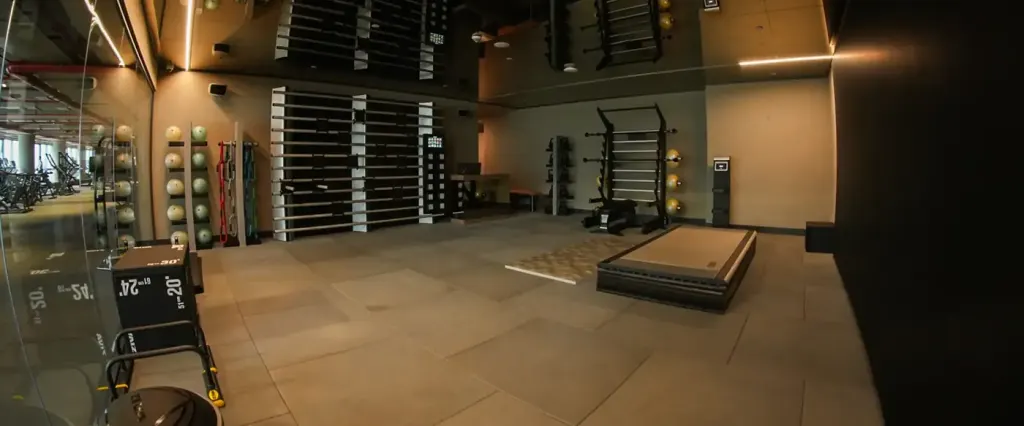
- Instead of outdoor functional training: Group classes and the functional area with sled, kettlebells and TRX.
- Instead of hiking: Incline treadmill walking or a stair climber.
- Instead of outdoor courts: The O'Padel Beytepe courts in the same complex.
Strategy 2: Put low-impact cardio and warm recovery at the centre
In winter, cardio that is easy on the joints and a warm recovery space stand out for several reasons:
- Weather independence: Snow or frost outside does not affect the programme at all.
- Low impact: Cycling, rowing and the elliptical suit people whose joints become more sensitive in the cold.
- Measurability: Tracking time, distance and heart rate is easier indoors.
- Full-body work: Options such as rowing offer a cardiovascular and strength component in a single session.
- Short distances: Being in the same complex reduces time spent outside in the cold.
Two low-impact cardio sessions a week through the winter largely make up for the cardio volume lost outdoors.
Strategy 3: Prioritise strength training
Winter is actually an advantageous period for building strength. Because races and outdoor events become rarer, the focus can shift to developing fundamental strength.
- Three strength sessions a week is a reasonable structure for winter.
- Emphasise multi-joint movements such as the squat, deadlift, press and row.
- Plan gradual load increases; a 12-week block fits the winter period well.
- When spring comes, you return to outdoor activities with a stronger base.
Strategy 4: Extend your warm-up
Someone coming into the club out of Ankara's frost has colder tissues than in summer. A standard five-minute warm-up may not be enough in winter.
- 10-12 minute warm-up: A reasonable duration for winter.
- Gradual structure: 4-5 minutes of light cardio, then dynamic stretching, then movement-specific preparation sets.
- Preparation sets: 2-3 sets of the main movement with a light load.
- Layered clothing: Keep an extra top layer on for the first 10 minutes and remove it once warm.
- After coming in from outside: Do not go straight into heavy sets.
Strategy 5: Daylight and vitamin D
Exposure to daylight decreases in the winter months. Vitamin D levels are known to tend to fall in people who work and train indoors.
- A 15-20 minute walk at lunchtime provides both daylight and movement.
- Any decision on vitamin D supplements should be based on a blood test; random high doses are not appropriate, so consult your doctor.
- Getting out into morning daylight can help support the sleep-wake rhythm.
- For people who train in the morning, this is an added advantage in making use of the daylight window.
Strategy 6: Making the right call when ill
Infections are the factor that interrupts training most in winter. A practical decision framework:
- Mild upper respiratory symptoms (runny nose, slight sore throat): A short, low-intensity session is usually tolerated; still, listening to your body is essential.
- Fever, body aches, chest symptoms, weakness: Do not train; in this case resting is the only right choice.
- Returning: Start gradually once symptoms have passed; 50-60% of normal volume is enough in the first week.
- Shared spaces: Using shared areas such as studios and changing rooms while infected is not appropriate for you or other members.
- If symptoms persist or are severe, see your doctor.
Strategy 7: Protect motivation with programme variety
A routine repeated in the same indoor space all winter can create mental fatigue. The most effective antidote is variety.
- At least one group class a week: HIIT, O'Ride Cycle, Cardio Kickbox or Total Body.
- Reformer pilates: A suitable block for posture and core work through the winter.
- Deep Stretch Yoga or mobility: A counterbalance to the stiffness that increases in winter.
- Padel: A different setting one day a week at O'Padel Beytepe in the same complex.
- Joining in-club goal programmes or shared challenges with friends.
Strategy 8: Set a winter goal
The strongest way to keep motivation alive in winter is to see this period not as empty waiting time but as preparation for a concrete goal.
- Strength goal: A squat or deadlift at a specific weight.
- Conditioning goal: Completing a set distance on the rowing ergometer under a target time.
- Skill goal: Learning your first pull-up or a specific reformer movement.
- Endurance goal: Running around Lake Eymir in spring or preparing for a running event.
- Consistency goal: Not missing three sessions a week for 12 weeks.
Sample winter programme (4 days a week)
- Monday: Lower-body strength (including a 12-minute extended warm-up) followed by 10 minutes of mobility and stretching.
- Wednesday: 30-40 minutes of low-impact cardio (rowing, cycling or elliptical) and 10 minutes of mobility.
- Thursday: Upper-body strength and a core block.
- Saturday: Group class (O'Ride Cycle or HIIT) plus reformer pilates or Deep Stretch Yoga.
- Spread through the day: A 15-20 minute outdoor walk at lunchtime for daylight.
Conclusion
Winter does not have to be the season of losing fitness; planned correctly, it can become the most productive time of the year for developing strength and technique. Moving the centre of your routine to an indoor facility, building low-impact cardio and recovery into your weekly plan, extending your warm-up, not neglecting daylight and recovery and tying the period to a concrete goal are the key strategies. If you live or work around Beytepe, Çayyolu, Ümitköy or İncek, indoor training that spans the functional area and reformer studio, group classes and the padel in the same complex is the most practical way to keep an uninterrupted programme going through the winter.
Related posts

Fitness Options Around Beytepe and Çayyolu–Ümitköy
Fitness options around Hacettepe's campus and Çayyolu–Ümitköy for anyone looking for a gym in Beytepe: access, opening hours and what O'Wellness Beytepe offers.
Recovering with stretching and mobility after nature walks in and around Beytepe
After a long walk around Lake Eymir or the Beytepe campus, good recovery saves the next day. We suggest an effective routine with stretching, mobility and sleep.
A Beytepe Guide for Newcomers: Sport, Health and Social Life
A practical, area-by-area living guide for newcomers to Beytepe and west Ankara, with tips on sport, health, social life and building a training routine in Yaka Beytepe.
